
DTF printing and ready-to-press transfers
DTF printing in Istanbul: on your garments, or as ready-to-press transfers
DTF (direct-to-film) printing puts a design on PET film, fixes it with adhesive powder and heat-presses it onto fabric. nakis.online prints DTF in its own Istanbul workshop on T-shirts, hoodies, tote bags, workwear and caps, from 10 pieces. It also sells the printed film as ready-to-press transfers: by the metre, per logo or in A3 and A4 sheets.
Last updated:
Key facts
- Who it suits
- Companies ordering logo garments; workshops and brands with their own heat press
- Ready-to-press film
- By the metre (roll), per logo, or as A3 and A4 sheets
- Minimum order
- 10 pieces on garments; for film, set in the quote
- Languages
- Turkish, English, German, Arabic, Russian
What is DTF printing, and how is it done?
DTF stands for direct-to-film: the design is printed not on the fabric but on a special PET film first. All the colours go onto the film in one pass, so a photo or a gradient follows the same route as a single-colour word, and no separate set-up is needed for each colour. The white layer printed behind the colours keeps the same design bright on a black sweatshirt and on a white T-shirt.
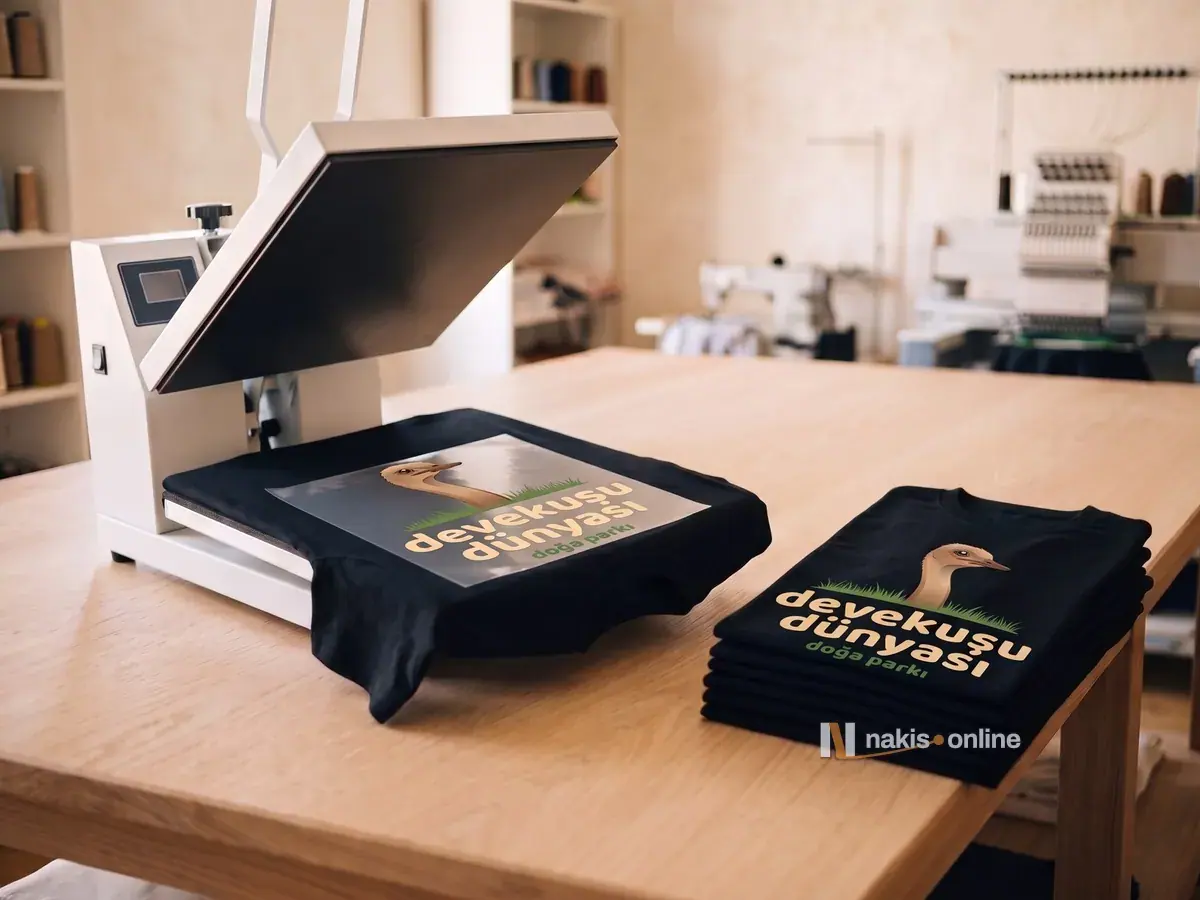
The design travels from the film to the garment in four steps:
- Printing: the colours of the design and the white layer behind them are printed onto the PET film.
- Powdering: while the ink is still wet, the film is coated with adhesive powder, which heat then melts and fixes.
- Pressing: the film is laid on the garment, and a heat press transfers the design to the fabric with heat and pressure.
- Peeling: the film is lifted off, and the design stays on the surface of the fabric as a thin, flexible layer.
Which products can be DTF-printed?
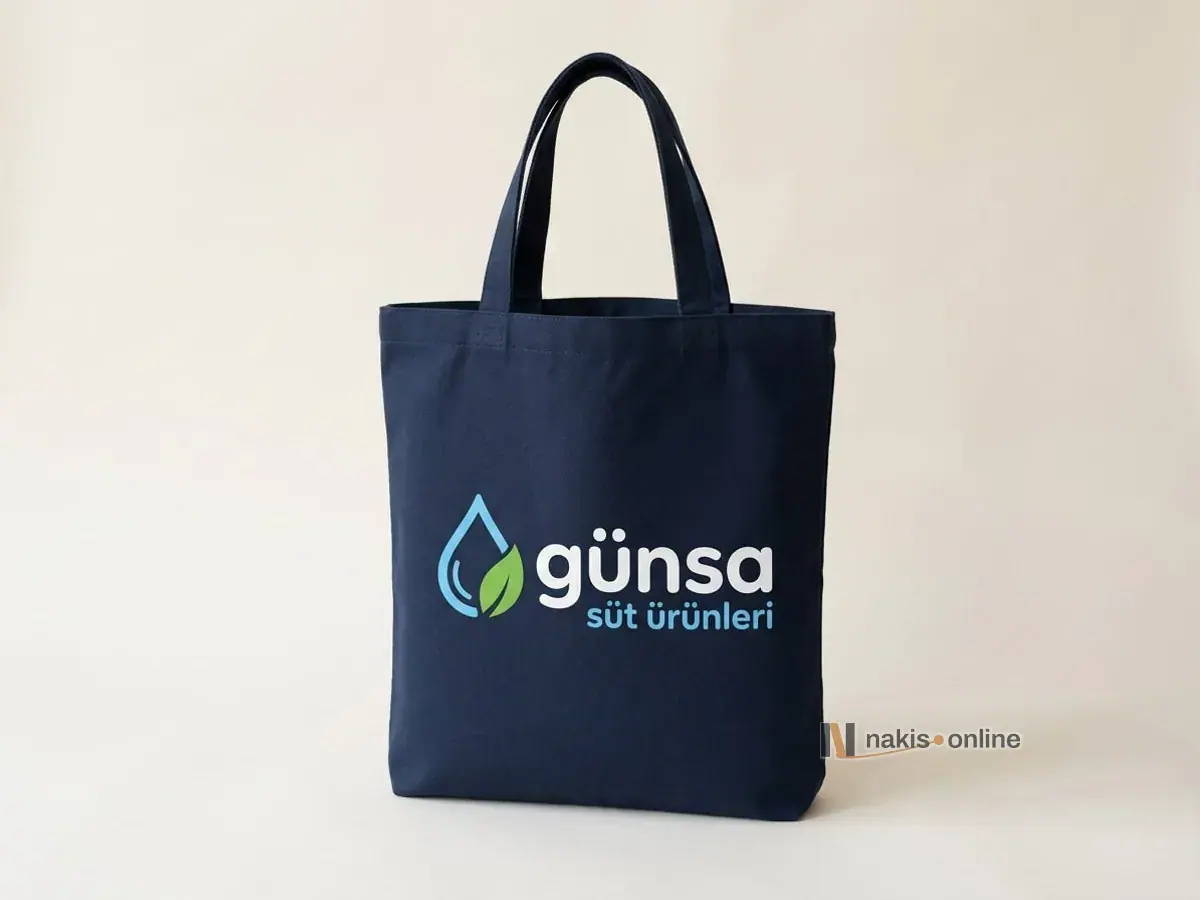
With DTF we print on T-shirts, polo shirts, sweatshirts and hoodies, tote bags, aprons and caps, and on workwear such as shirts, overalls, vests, jackets, chef jackets and medical uniforms. You can send your own products or leave the sourcing to us; when we source them, the model, colour and sizes are chosen together in the quote, and the time needed to obtain them is added to the lead time.
For positions, sizes and blank options by product, see our pages on T-shirt printing, hoodies and sweatshirts and tote bags. The same logo can also be embroidered, and one order can mix printed and embroidered items; the timing of a combined order is set in the quote.
The position and the behaviour of the print change with the product. These are common positions in the trade; the exact position and size are settled in the quote:
| Product | Common print positions | What to keep in mind |
|---|---|---|
| T-shirts | Left chest, centre front, back, sleeve | On thin jersey, a large solid area changes how the fabric feels |
| Polo shirts | Left chest (beside the placket), back | How the print looks on the honeycomb piqué surface is settled in the quote |
| Sweatshirts and hoodies | Back, chest, sleeve | On a hoodie, a chest print is planned around the kangaroo pocket and the hood cords |
| Tote bags | Front and back | Gussets, handles and seams limit the print area |
| Aprons | Bib, above the pocket | Straps and pocket seams decide where the print goes |
| Shirts and chef jackets | Chest, above the pocket, sleeve | The button line and the pocket narrow the print area |
| Overalls, vests and jackets | Chest, back, sleeve | The fabric content and any surface coating decide suitability; settled in the quote |
| Medical uniforms | Chest, sleeve | On uniforms washed often and hot, suitability is settled in the quote, based on the wash programme |
| Caps | Front panel, side panel | The curve and seams of the panel limit the size; settled in the quote |
Ready-to-press DTF transfers: by the metre, per logo or by the sheet
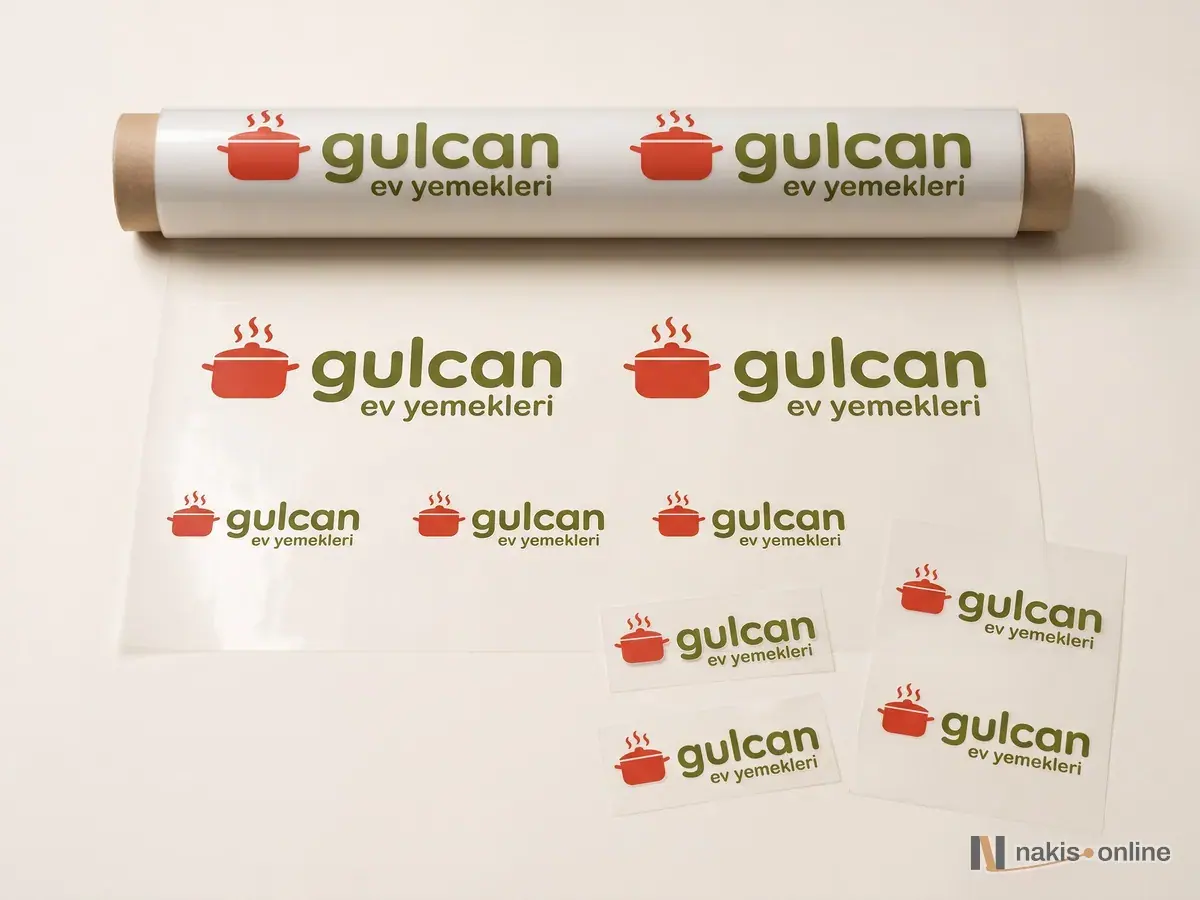
A ready-to-press DTF transfer is a film that has been printed and powdered and is waiting for the heat press. Several designs nested on one film are often called a gang sheet. A cured film can be stored and pressed later, so you buy the print from us and apply it on your own production schedule.
We also sell the DTF-printed film without a product: by the metre (on a roll), per logo, or as A3 and A4 sheets, and you apply it to your products with your own press. This is the option for trade buyers: workshops with their own heat press, small brands and promotional companies. We print and powder the design, and you apply it. How you buy depends on how many designs you have and how big they are:
| How it is sold | How it is prepared | When it fits |
|---|---|---|
| By the metre (roll) | Designs are arranged along the roll and charged by the metre | Many logos in different sizes, or several separate designs |
| Per logo | Each logo is cut separately and charged per piece | A set number of copies of the same logo |
| By the sheet (A3 or A4) | Designs are placed on a sheet of standard size | Designs that fit the sheet |
Ordering from outside Istanbul: shipping, customs and written quotes
We ship orders from our Istanbul workshop to addresses across Türkiye (Turkey) and abroad; the carrier and the transit time depend on the destination country. The shipping cost is set in the quote; for orders abroad, we discuss customs and taxes with you at the quote stage and help you along the way. We are not customs brokers, so for the rules on your import, ask your own broker or the customs authority in your country.
If your blank garments are already in your own country, ready-to-press film can be the simpler route: only the film travels, and you press it on the garments you already hold.
Everything is printed and pressed in one workshop in Bağlar, Bağcılar, on the European side of Istanbul. Finished orders go out by courier or can be collected from the workshop by appointment. We can handle quotes and order correspondence in writing in Turkish, English, German, Arabic or Russian.
How large can a DTF print be?
We print at any size, from a small chest logo to a design that covers the whole back; the exact size is settled in the quote, based on the design and the product. When you choose the size, check two things: that the smallest text in the design can still be read, and that the print fits the flat area of the product. On company garments, the left-chest logo usually stays small, and the company name or a large design moves to the back. Common widths and positions are in the table on our T-shirt printing page.
What artwork should you send for DTF printing?
Vector artwork gives the cleanest result: a logo as AI, EPS, PDF or SVG scales to any size without losing sharpness. If you only have a PNG or JPG, send it anyway; we tell you in the quote whether it can be printed.
Because a white layer is printed behind the colours, semi-transparent shadows and soft, feathered edges can print in unexpected ways; a file with a transparent background and clean edges avoids that from the start. For pixel images, the resolution has to be high enough for the print size.
What decides the price of DTF printing and film?
For printed work, the price depends on the size and position of the print, the quantity and the product; we give you the quote in writing. For ready-to-press film, the quote follows the amount: the metres, the pieces or the sheets. The number of colours does not change the price of a DTF print, because all the colours go onto the film in the same pass.
We don’t publish a fixed price list or a price per metre: the same metre carries a different number of logos depending on their size, and on garment orders the product itself can be part of the quote. Send the design, the size and the quantity, and you get the price in a written quote.
How well does a DTF print stand up to washing?
A correctly applied DTF print stays on the surface of the fabric as a flexible layer. How long it lasts depends on the temperature, time and pressure of the application, and on how the item is washed and dried. On garments, we do the pressing in the workshop; with ready-to-press film the press is yours, so the right settings directly affect the life of the print.
The care routine is short: turn the item inside out, wash it at the temperature on its care label, avoid high-heat drying and never let the iron touch the print directly.
Besides DTF, which other printing methods do we use?
Our workshop also does sublimation and flex (cut vinyl) printing, and makes raised (3D) TPU logos and UV DTF stickers. Raised TPU logos and UV DTF stickers have a minimum order of 10 pieces and, as with DTF, are ready on average 3–5 days after order approval; for sublimation and flex, the minimum quantity and the timing are settled in the quote.
- Sublimation: the design is printed on paper with special ink, and heat carries it into the polyester fibre. It is used on white or light-coloured polyester and leaves no layer you can feel.
- Flex (cut vinyl): coloured vinyl is cut to the design, weeded and heat-pressed. It suits simple, single-colour lettering and shapes.
- Raised (3D) TPU logo: pressed onto fabric, it leaves a raised logo or label with a silicone-like feel.
- UV DTF sticker: printed on film and pressed onto a hard surface such as a mug, a flask or a pen, not onto fabric.
Questions about DTF printing and transfers
What is the difference between DTF and UV DTF?
DTF is for fabric, UV DTF for hard surfaces. In DTF, a heat press carries the design from the film onto a textile product such as a T-shirt, a bag or a cap. A UV DTF sticker is printed on film and pressed by hand onto a hard surface such as a mug, a flask or a pen. We make both in our workshop; surfaces, sizes and delivery are on our UV DTF stickers page.
How do I apply ready-to-press DTF film on my own press?
Lay the film on the product and apply heat, time and pressure in a heat press; depending on the film, it is peeled hot or after cooling. These values vary with the film and the fabric, so we settle the application conditions with you in the quote. We recommend testing a few pieces before pressing a batch.
Can ready-to-press DTF transfers be applied with a household iron?
We recommend a heat press. A household iron cannot give the same temperature and pressure across the whole design, so one part may hold while another lifts at the edge. A heat press delivers set time, temperature and pressure, which is why we make ready-to-press transfers for workshops and brands that work with their own press.
Should I buy DTF film by the metre or per logo?
It depends on how many designs you have and how big they are. With many logos in different sizes, or several separate designs, buying by the metre lets us arrange them all along one roll. If you need a set number of copies of one logo, buying per logo is simpler, and a design that fits a standard size can go on A3 or A4 sheets. We choose the right form together when we see your design.
Does DTF work on polyester and blends?
Yes. DTF is used on cotton, polyester and blends, and thanks to the white layer the same method works on light and dark fabrics. On heat-sensitive, coated or very stretchy fabrics, the press settings decide the result; tell us what is on the fabric label, and suitability is settled in the quote.
Can DTF be printed on caps?
Yes. On caps the print mostly goes on the front panel, sometimes on a side panel. The curve of the panel and its seams limit the size of the print; the exact size and position are settled in the quote. If you would rather have the logo in thread, see our custom embroidered caps.
Do you also do DTG printing?
No, DTG is not one of our methods. In DTG, ink is printed directly onto the garment and the fabric is pre-treated first; water-based ink gives its best results on natural fibres such as cotton. In DTF the design goes on film first, so no pre-treatment is needed and the same method works on cotton, polyester and blends. If you had DTG in mind for a design, send the file and we tell you in the quote whether it suits DTF.
Quote
Send your design for DTF printing or film
Send the design and the product with the quantity, or for film the metres, pieces or sheets you need, and the delivery city or country. We reply in writing with the price, the timing and the shipping cost.
Working hours: Monday–Saturday 08:30–19:00 · Istanbul time (UTC+3)