
Company, hospitality and medical uniforms
Workwear and staff uniforms with your logo, embroidered in Istanbul from 10 pieces
Workwear and staff uniforms with your company logo: nakis.online embroiders jackets, fleece and quilted vests, softshells, shirts, overalls, aprons, chef jackets and scrubs in its Istanbul workshop, from 10 pieces, and can add a different name to each piece. Send your own uniforms or let us source them; production starts after sample approval.
Last updated:
Key facts
- Minimum order
- 10 pieces
- What we embroider
- Jackets, fleece and quilted vests, softshells, shirts, overalls, aprons, chef jackets, scrubs, doctors’ coats
- Lead time (embroidery)
- 3–5 working days after sample approval (10–500 pieces); sourcing adds time
- Embroidery file
- DST as standard; PES on request
- Languages
- Turkish, English, German, Arabic, Russian
Which workwear and uniforms do we embroider with your logo?
Company workwear starts with the job, not with the look. Warehouse, field and delivery crews need freedom of movement and warmth; shops, receptions and offices want a tidy uniform that carries the brand; kitchens and clinics need clothing that survives hot, frequent washing. We embroider all of them in one workshop, from 10 pieces per order, and the same logo drawing is adjusted to each fabric.
For the everyday layers, see our pages on custom polo shirts, hoodies and sweatshirts and T-shirt printing. The table below covers the rest of the uniform.
| Garment | Usual logo position | What the fabric asks for |
|---|---|---|
| Work jacket, parka | Left chest, sleeve, back | Lined and padded: lighter fill; large back logo in appliqué |
| Softshell jacket | Small logo on the left chest | Stretchy membrane: cut-away backing, few stitches |
| Fleece jacket or vest | Left chest | Cut-away below, water-soluble topping above the pile |
| Quilted vest | Inside one quilted channel | Low density, so the padding is not crushed |
| Shirt | Above the pocket or left chest | Woven: tear-away backing, a slightly smaller logo |
| Overalls | Left chest and company name on the back | Woven: tear-away; never over reflective tape |
| Apron | Bib panel; name above the pocket | Canvas or gabardine: tear-away; print possible |
| Chef jacket | Logo left chest, name on the opposite chest or collar | Polyester thread for hot, bleached washes |
| Scrubs and doctors’ coats | Logo left chest, name and title beneath or above the pocket | Stretch scrubs: cut-away; coats: woven |
Jackets, fleece and softshells: logo placement on outerwear
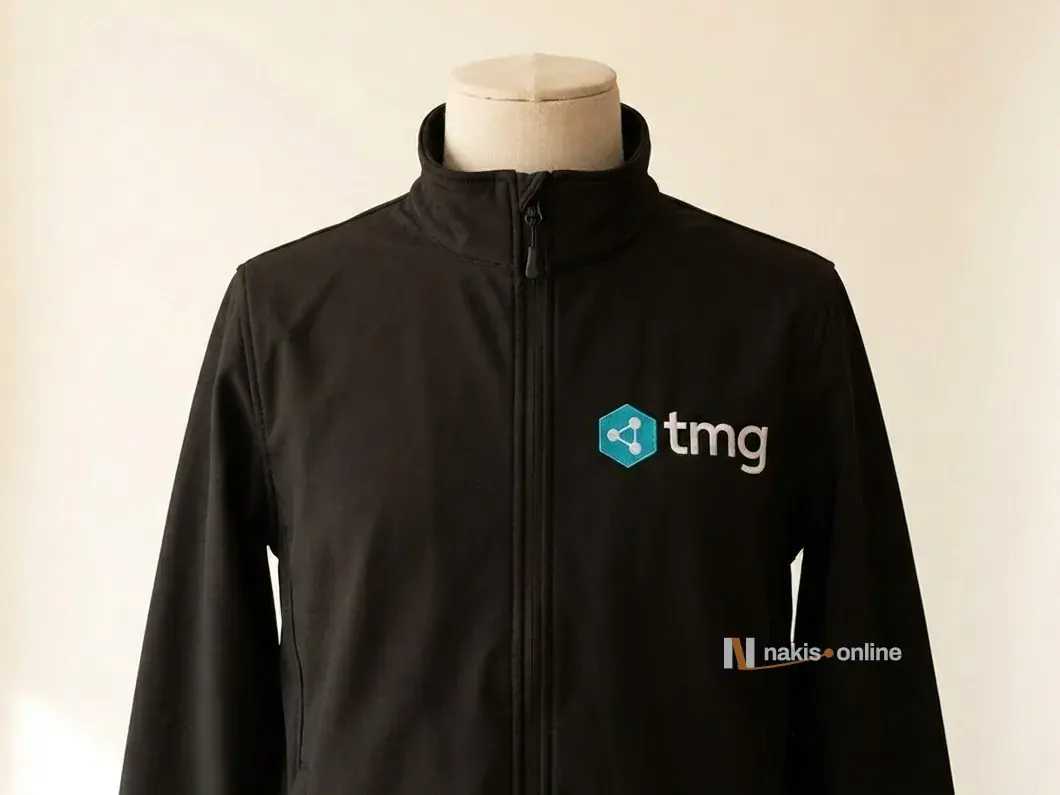
On a finished jacket, the hoop cannot go everywhere. The chest, the sleeve and the back can usually be hooped without opening the lining; chest pockets, the zip line, flapped pockets and seam junctions get in the way. A left-chest logo is usually 7.5–10 cm wide and sits inside the zip, a sleeve logo usually 6–8 cm, and the back carries a company name or a large emblem. On a padded or lined jacket the needle passes through every layer, so we lower the density and work more with outlines; a back logo of 25–30 cm in full fill would be stiff and heavy, so wide areas are filled with fabric in appliqué instead.
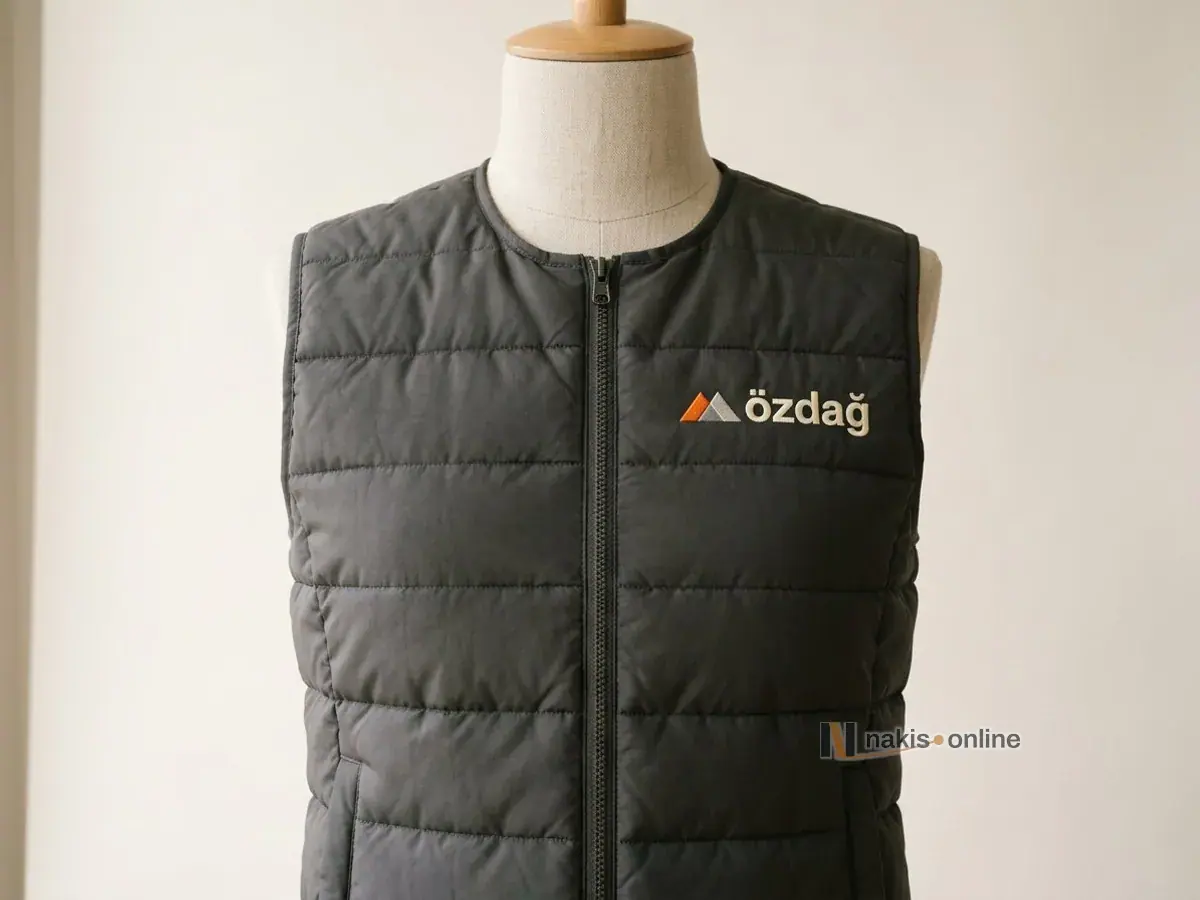
A softshell is stretchy and often has a membrane that keeps rain out. The needle pierces that membrane with every stitch, so a dense logo weakens the area against rain; on softshells we use a cut-away backing, a small logo and few stitches. Fleece has a brushed pile that swallows thread: a cut-away backing goes below, a water-soluble film goes on top to keep the stitches above the pile, and fine lettering stays above about 5 mm in height. On a quilted vest, the logo fits best inside one channel; wider logos are turned into a single line of lettering or sewn on as a patch.
Shirts and overalls: woven fabrics and reflective tape
On a shirt with a pocket, the classic position is a few centimetres above the pocket opening, aligned with the pocket’s centre; on a shirt without one, the left chest. A shirt logo is kept a little smaller than on a polo shirt, at or below the lower end of the usual 7.5–10 cm. Poplin, oxford and gabardine are woven and do not stretch, so a tear-away backing is enough and is removed after stitching; thin poplin does not take a dense fill, so we lower the density to stop it puckering.
Overalls carry the logo on the left chest and the company name across the back, usually 25–30 cm wide in a bold, simple typeface that stays readable under oil and dirt. We never stitch over reflective tape: the logo goes on the fabric between the strips. On high-visibility garments the logo must not reduce the fluorescent area below the minimum of the garment’s class, so we plan its size to the limit stated by the garment’s maker.
Chef jackets and aprons for restaurants, cafés and shops
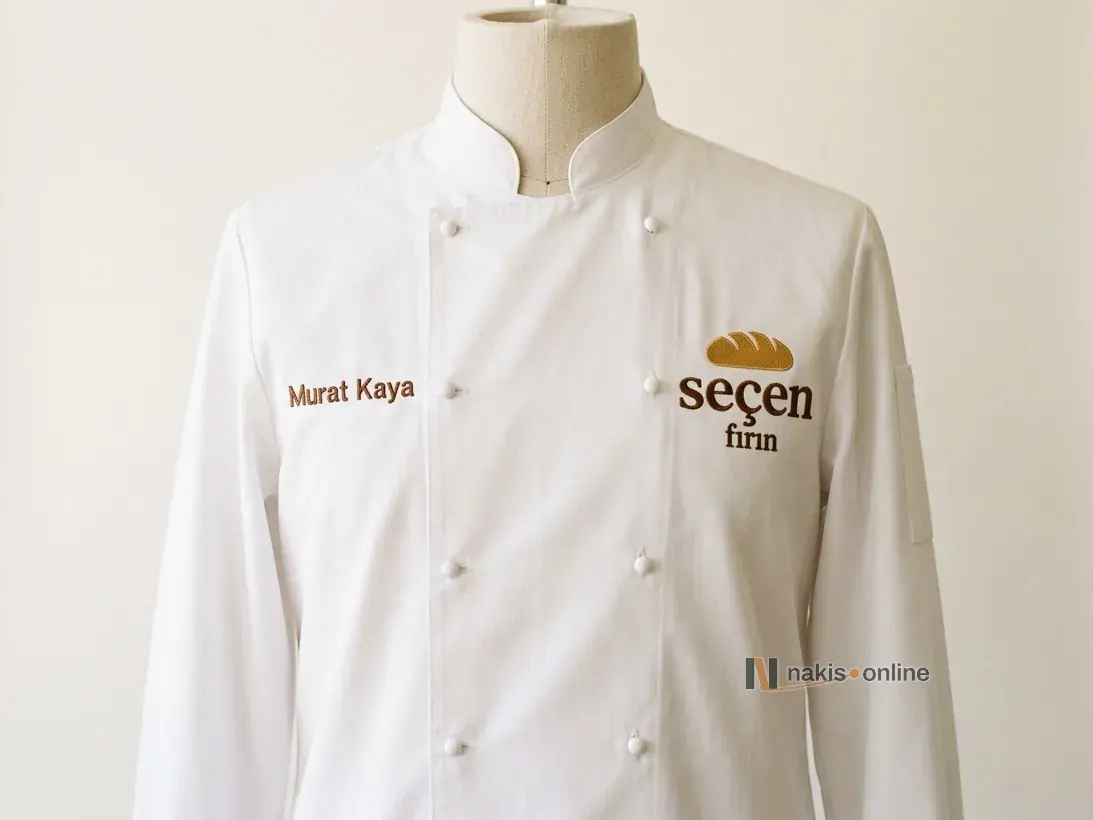
On a chef jacket, the restaurant logo goes on the left chest and the chef’s name on the opposite chest or the collar. Kitchen clothing is washed hot, often and frequently with bleach, so we use polyester thread there; viscose has a beautiful sheen but does not stand up to bleach, and we don’t recommend it for kitchens. Chef jacket fabric is woven, so a tear-away backing is enough.
On a bib apron, the logo goes in the centre or on the left of the bib, and a name above the pocket; each apron in a batch can carry a different name. On a waist apron, the flat area is narrow and usually split by the pocket, so the logo goes above the pocket or in a lower corner. The straps and the pocket itself are never embroidered: they are several layers thick and do not lie flat in the hoop. For a colourful design or one that covers the whole bib, an apron can also be printed with DTF in our workshop; printed aprons are ready on average 3–5 days after order approval.
Scrubs, doctors’ coats and medical uniforms with logo and name
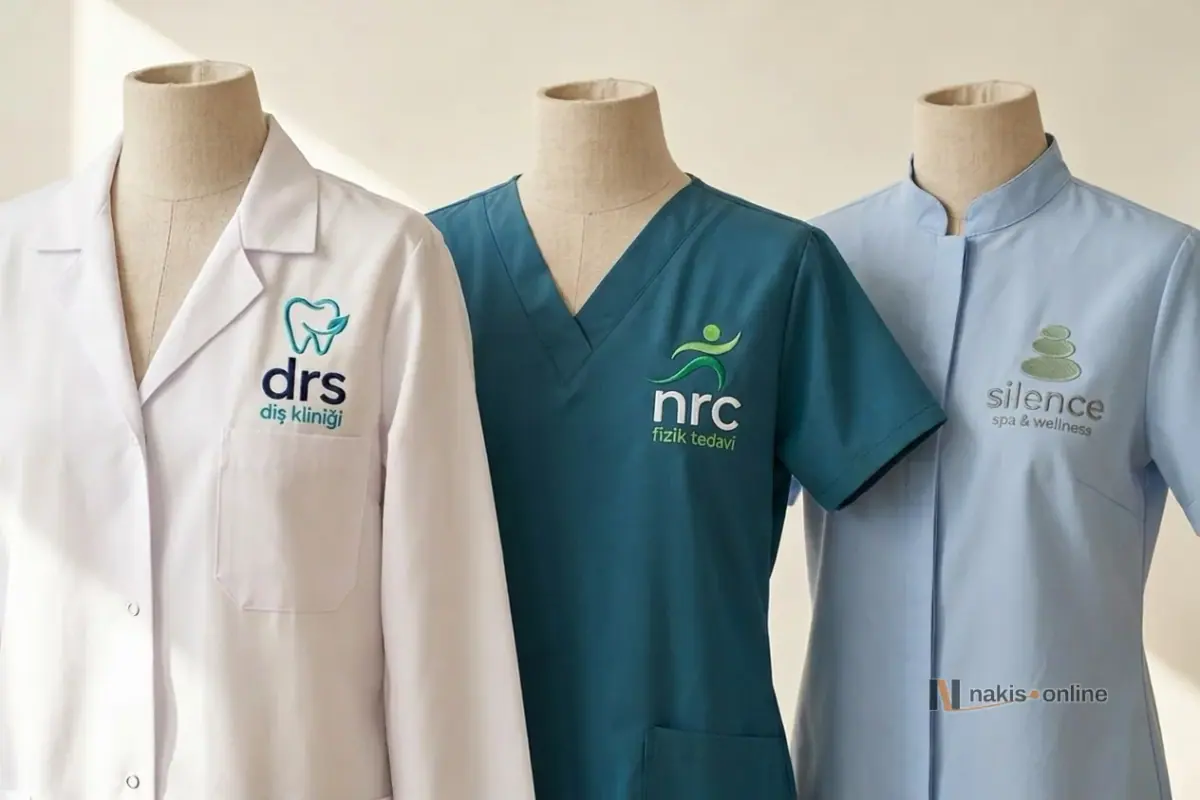
On scrubs, the logo usually goes on the left chest, and the name beneath it or on the sleeve. On a doctor’s coat, the institution’s logo sits on the left chest and the doctor’s name and specialty above the pocket opening. Scrubs are often stretchy, so a cut-away backing keeps the logo flat when the fabric moves; coats are woven. The logo drawing stays the same for both, but the file is adjusted to each fabric, so each gets its own sample.
Scrubs that go into a shared laundry pool can carry the logo only, so any set can be handed to anyone; where names matter, a hook-and-loop name patch can move with the person. For the hospital wash, we use polyester thread; the exact disinfection programme should be checked against your institution’s protocol on the sample. For coats that go into an autoclave, we make no promise: the thread maker’s data cover washing and bleaching, not steam sterilisation.
A different name on every piece
Names are ordinary batch work: the logo stays the same and the name changes from piece to piece. Send the list as a spreadsheet with the spelling checked, marking which name goes on which size and garment; special characters such as İ, Ş or Ğ are stitched exactly as written. A name and a job title fit on two lines, the second slightly smaller. In embroidery, letters should not be smaller than about 5 mm in height, and a satin column needs a width of at least about 1 mm. We ask for your written approval of the list before the run, and how a named batch counts towards the minimum of 10 pieces is settled in the quote.
Will the logo survive industrial laundry?
We use Madeira polyester embroidery thread; where extra sheen is wanted, viscose thread can be chosen too. On textiles that are washed often and hot, or treated with bleach, the durability comes from the polyester fibre, and for that kind of work we use polyester thread. According to the thread maker’s data sheet, the polyester thread we use is suitable for industrial laundry, so the weak point of a work uniform is usually the base fabric or the tape, not the embroidery. On dark overalls in oily workshops, white, yellow or light grey thread stays readable longest; on light fabric, an oil stain soils the thread too.
Your uniforms, or shall we source them?
If the uniforms are in your stock room, send them with the quantity per size and tell us what they are: lined, padded or membrane jacket, fleece or woven, stretch or not. The backing, the density and sometimes the position follow from that.
If you would rather we source them, tell us the garment type, the colour, the size split and the quantity; we obtain the garments, embroider your logo and deliver the batch. When we source the products, the model, colour and size options are agreed with you in the quote, and the time needed to obtain them is added to the lead time. The sample is stitched on the model chosen for the run, because pockets, zips, channels and linings only show their exact position on the garment itself.
How a uniform order runs, and what to send for a quote
We digitize your logo for each fabric, stitch a sample on the garment from your order and start the run once you approve it. For orders of 10–500 pieces, the typical time after sample approval is 3–5 working days; orders with several positions, mixed garments or work through the lining are timed in the quote, and sourcing adds the time to obtain the garments. The price depends on the stitch count, the number of colours, the number of logo positions, the quantity and the product; we give you the quote in writing. For a quote in one round, please send:
- your logo file, vector if you have it, with any Pantone references
- each garment type, and whether you send it or we source it
- the quantity per garment, colour and size
- the positions on each garment, and the list of names or titles if any
- the care conditions: hot or industrial washing, bleach, hospital disinfection
- the delivery city and country, and the date you need the uniforms by
Questions about workwear and uniforms
Does embroidery affect the waterproofing of a jacket?
At the logo, it can: the needle pierces the membrane and the coating with every stitch. We reduce the risk with a small, lightly stitched logo in a position less exposed to rain. If waterproofing is critical, a patch sewn on only at its edge makes fewer holes; we can compare the two on the sample.
Can you embroider a logo on the flap of a pocket?
Usually not. A sewn flap is two layers plus a seam allowance and does not stretch flat in the hoop. The logo goes above the pocket or on the opposite chest; a chest panel without a pocket always gives the cleanest result.
Can one uniform order mix jackets, shirts and aprons?
Yes. The logo drawing stays the same, but each garment gets its own embroidery file and its own sample, because a padded jacket, a poplin shirt and a canvas apron need different backings and densities. List the quantity and sizes of each garment separately in your request.
How should embroidered work uniforms be washed?
Follow the garment’s care label; the polyester thread copes with whatever the fabric allows. Turn garments inside out, and never iron directly over the embroidery. Fleece lasts longer washed cool and dried without high heat; softshells are usually washed cool and without fabric softener, which spoils the membrane and the water-repellent finish.
Quote
Get a quote for your staff uniforms
Send the logo, the garments, the quantities, any names and the delivery country. We reply in writing with the price, the timing and the shipping cost.
Working hours: Monday–Saturday 08:30–19:00 · Istanbul time (UTC+3)