
Caps, hats and beanies for teams and events
Custom embroidered caps and beanies with your logo, from 10 pieces
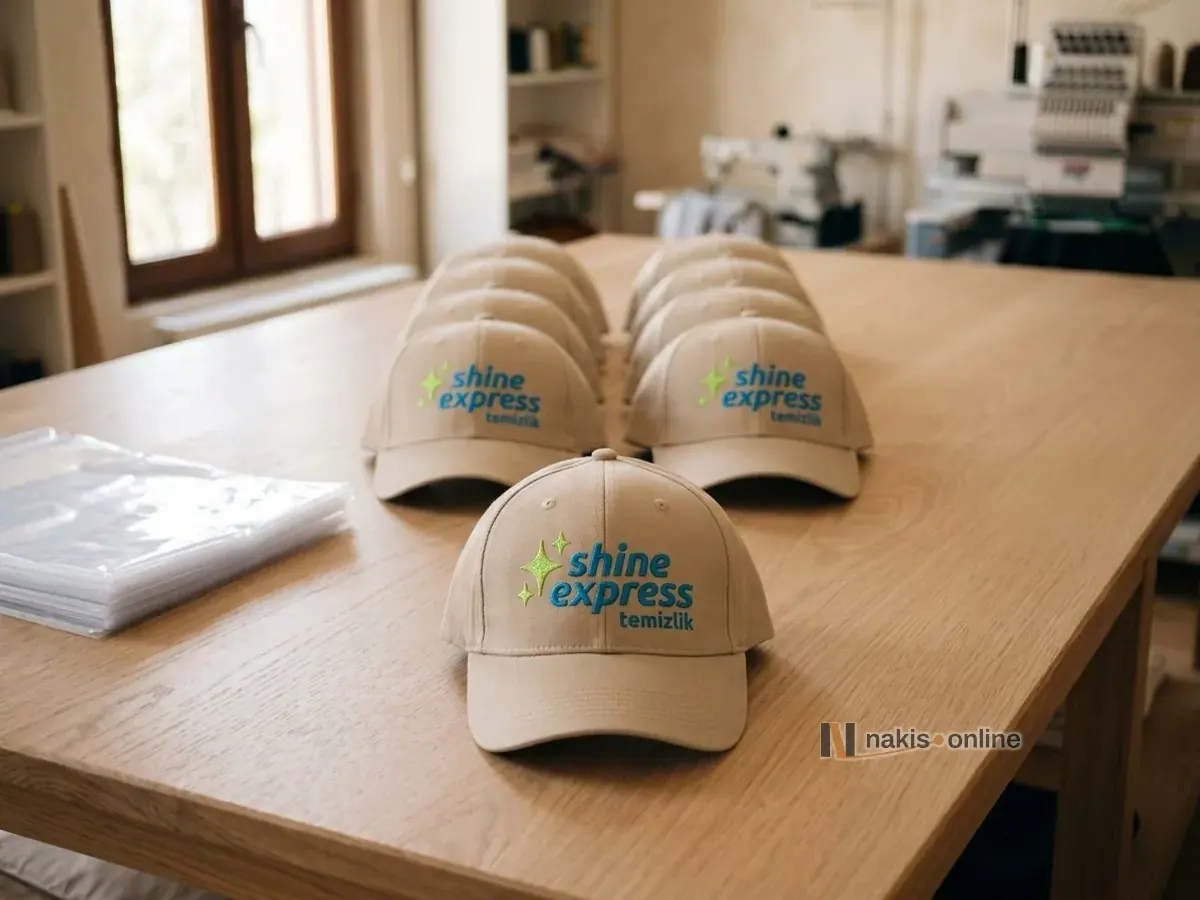
Custom caps with your logo: nakis.online embroiders the front panel of finished caps in its Istanbul workshop, flat or in 3D puff, where the stitches run over a foam layer and the letters stand up. Beanies get a smaller, flat logo on the cuff. From 10 pieces; send your own caps or let us source them. The run starts after sample approval.
Last updated:
Key facts
- Minimum order
- 10 pieces
- Thread
- Madeira polyester embroidery thread (and viscose)
- Embroidery file
- DST as standard; PES on request
- Languages
- Turkish, English, German, Arabic, Russian
Which cap carries an embroidered logo best?
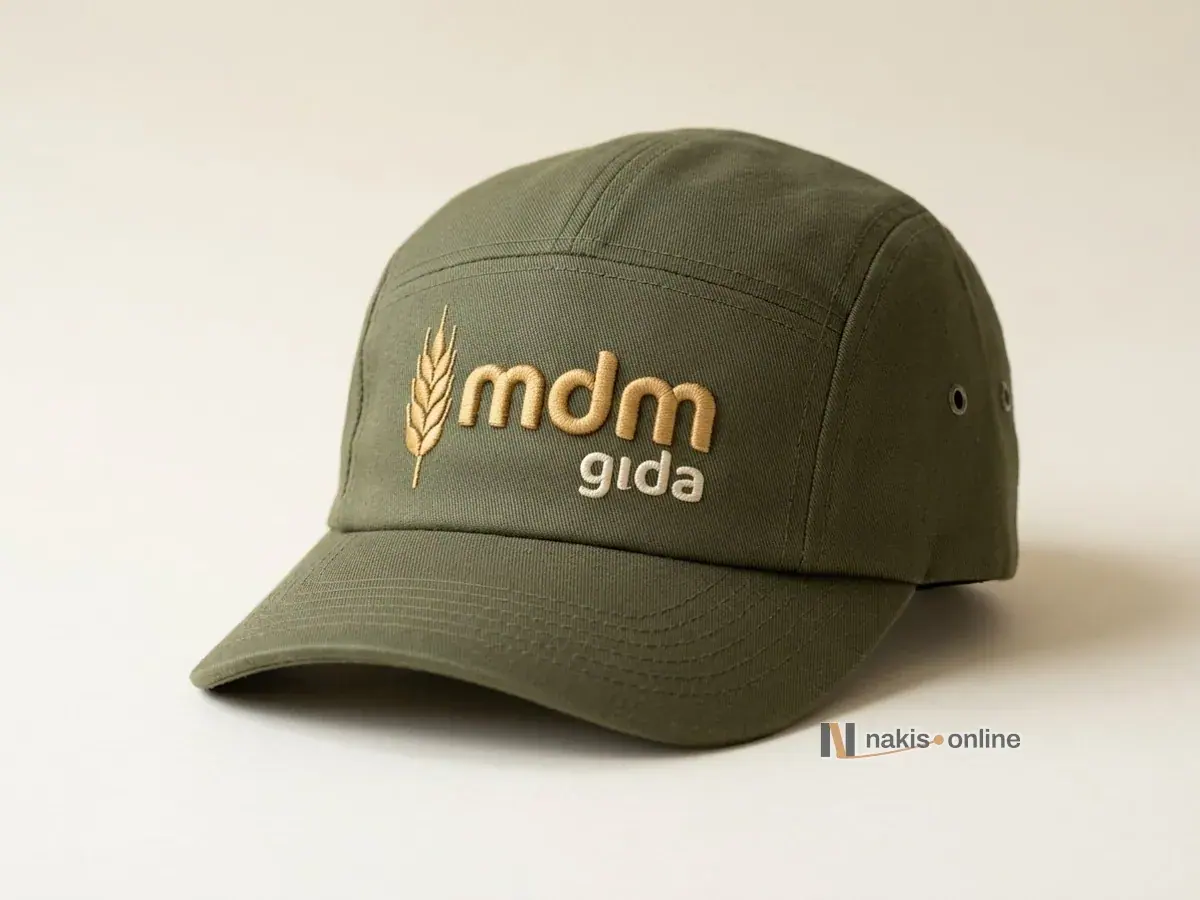
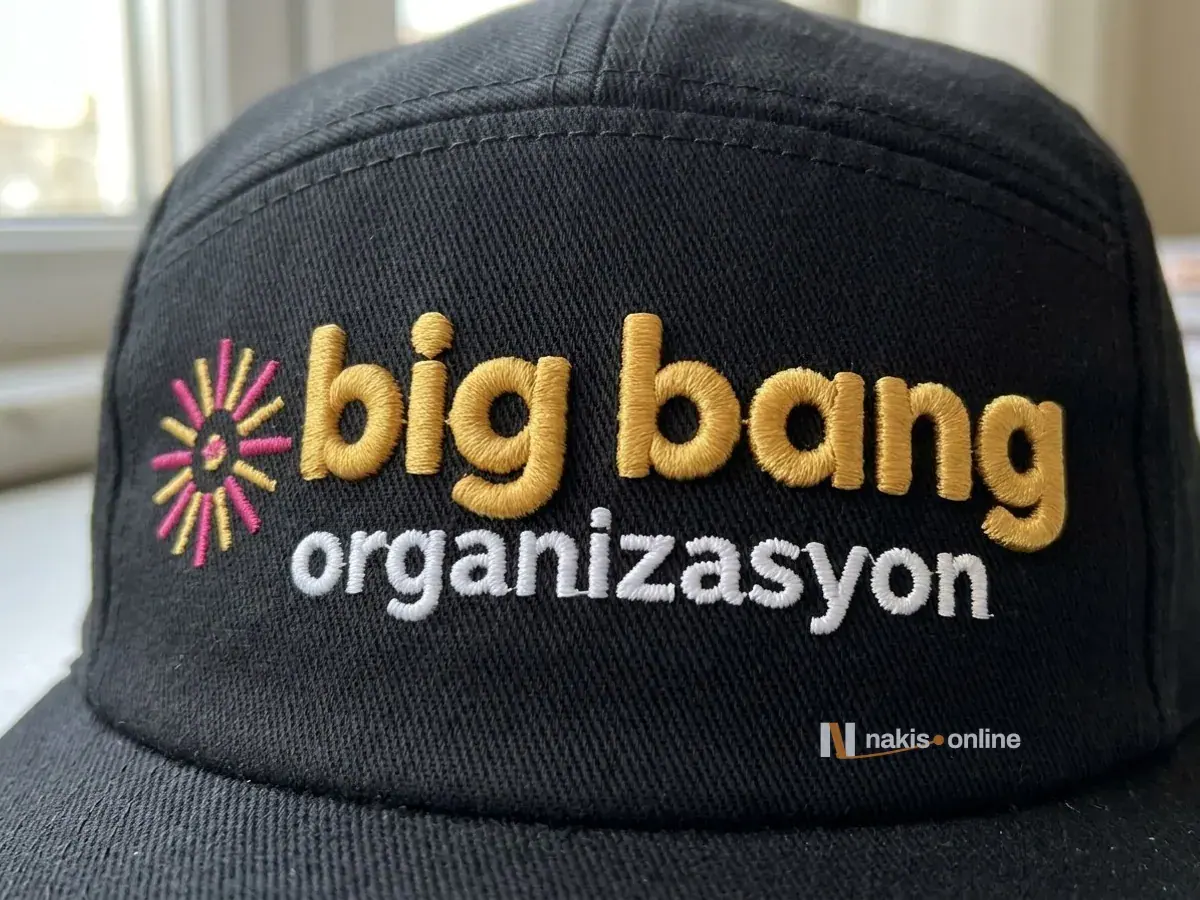
On a five-panel cap the front panel is one piece, so the logo sits on a seamless surface. On a six-panel cap a seam runs down the centre of the front, right through the middle of the logo. The seam does not stop the embroidery, but it can split thin lettering in two; on six panels we keep the letters a little bolder and try to land the seam in the gaps of the design.
A structured cap, with a stiffened front panel, holds the embroidery upright. On an unstructured cap with a soft front, the fabric moves more in the hoop, so we set up a lighter fill with a strong underlay instead of a dense one. Cap fabrics such as cotton twill and gabardine are woven, so a tear-away backing is enough; on a trucker cap with a mesh back, the logo still goes on the woven front panel.
| Cap type | Front panel | Suggested technique | What to watch |
|---|---|---|---|
| Five-panel, structured | One piece, seamless | Flat embroidery or 3D puff | The logo is scaled to the curve of the panel |
| Six-panel, structured | Seam down the centre | Flat embroidery or 3D puff | Thin lettering can be split by the seam |
| Unstructured (soft front) | No stiffener, flexible | Flat embroidery | Puff not recommended; lighter fill, strong underlay |
Flat embroidery or 3D puff on a cap?
Flat embroidery renders thin lines, small lettering and many-coloured logos cleanly. In 3D puff, a layer of embroidery foam goes on the panel, the satin stitches run over it and the letters rise from the surface. For the foam to rise evenly, the letters need to be bold with soft corners; fine serif typefaces fall apart in puff.
Puff gives its best result on a structured front panel. The two can share one design: the main letters of the logo in puff and a short slogan beneath in flat embroidery. On a soft cap, foam collapses with the fabric and the edges do not close neatly, which is why we suggest flat embroidery there.
How big can the logo be on the front of a cap?
The usable area of the front panel is limited by the seam of the peak, the seams of the side panels and the curve that narrows towards the button on top. The exact size depends on the cap model and is set on the sample; from a vector file we first prepare a layout to scale. To see your logo on a cap before that, the photo to embroidery demo can show it on a cap; the preview is representative.
A long horizontal logo rises towards the edges on a curved panel and runs over the side seams, so we either reduce it or split it into two lines. Besides the front, the side panels and the area above the back closure can be embroidered; the back usually carries a short web address or slogan, since the buckle or hook-and-loop strap narrows the space. Each extra position is a separate set-up and a separate line in the quote.
Why does a cap need its own embroidery file?
A file digitized for a flat garment shifts on a cap. In a cap file, the stitches run from the centre outwards and from the bottom up, so the fabric is pushed in one direction inside the hoop and the logo does not distort. If your logo was digitized for a T-shirt or a polo shirt, we re-edit it for caps. We digitize your logo in our workshop, turning it into a file the embroidery machine can read.
A mixed order of black, navy and white caps uses the same embroidery file: a DST file carries the stitches, not the thread colours, which are assigned to the needles on the machine. Light thread on a dark cap and dark thread on a light one need no new file; the contrast on each cap colour is checked on the sample. When we source the caps, the available cap colours are agreed in the quote.
Custom beanies with logo: what changes on a knitted hat?
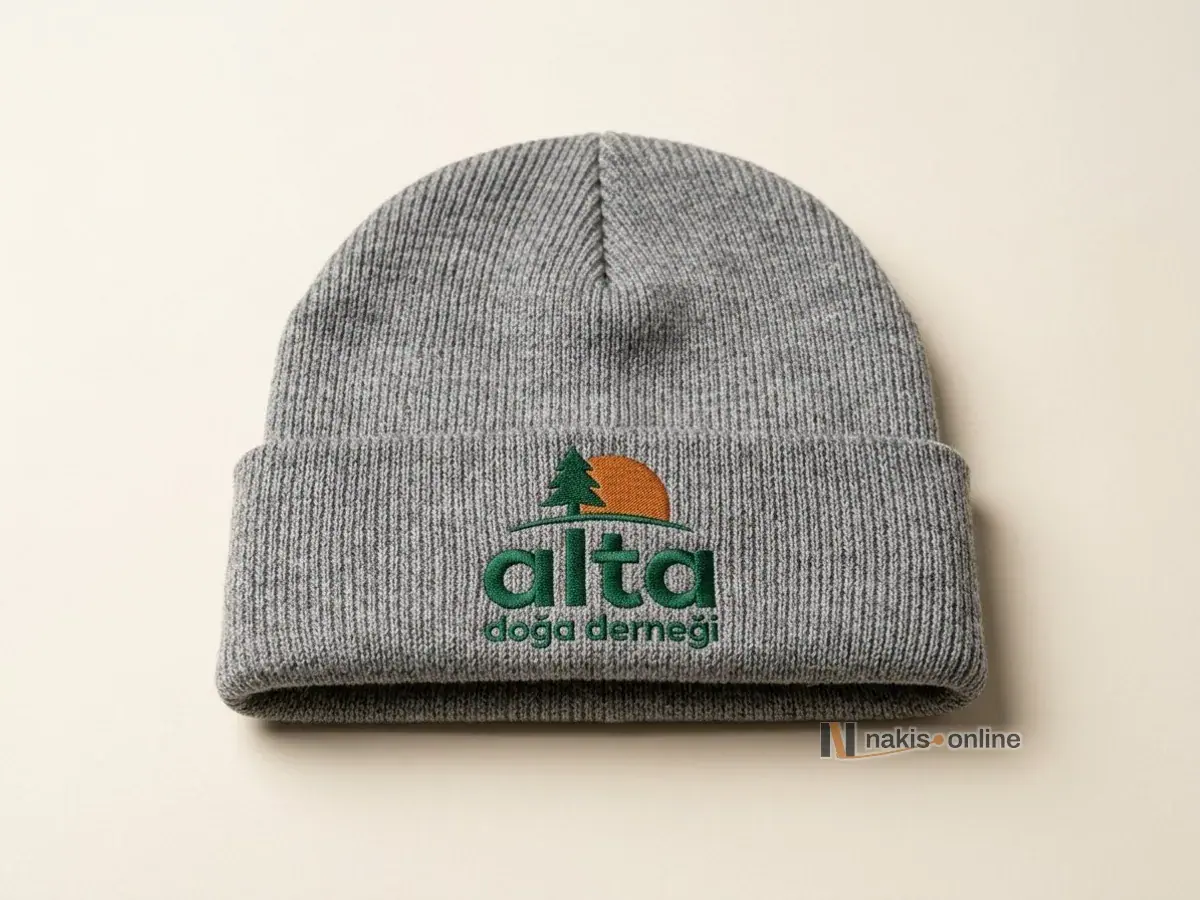
On a beanie with a turned-up cuff, the logo goes on the centre front of the cuff, just above the forehead, where it is seen most. We embroider the cuff unfolded, so when it is turned up the back of the stitching and the backing stay inside the cuff, away from the head. On a beanie without a cuff, the logo sits a little above the forehead.
Knit stretches, so a cut-away backing stays behind the stitches, the fill is kept light and the beanie is hooped flat without stretching it; an over-stretched beanie shrinks back after stitching and takes the logo with it. Letters stay above about 5 mm, more on a chunky knit. 3D puff is tried only on a thick, tightly knitted cuff with a small, bold logo; the same logo can be puff on the cap and flat on the beanie.
Your caps, or shall we source them?
If the caps are already in your hands, we embroider them. How much room the peak leaves and whether the front panel fits the cap frame vary from model to model, so we like to see the cap itself or a clear photo first. In a mixed-colour batch, give the quantity of each colour separately.
If you would rather we source them, tell us five or six panels, structured or soft front, the colour, the back closure (buckle or hook-and-loop) and the quantity; we obtain the caps, embroider your logo and deliver them. When we source the products, the model, colour and size options are agreed with you in the quote, and the time needed to obtain them is added to the lead time. Beanies can be sourced the same way. The minimum of 10 pieces applies to your own caps as well.
What do we check on the sample, and how long does the run take?
Production starts after you approve the sample. On it we check that the logo is centred on the panel, that the edges of the puff are fully closed and how close the logo comes to the peak seam. We also turn the cap in our hand under light, since the sheen of satin stitches on a curved surface changes with the angle; on a beanie we stretch the cuff and let it go to see that the logo recovers with the knit. For orders of 10–500 pieces, the typical time after sample approval is 3–5 working days; when we source the caps, the time to obtain them is added.
The price depends on the stitch count, the number of colours, the number of logo positions, the quantity and the product; we give you the quote in writing. A puff logo, a second position on the side or the back, and a many-coloured design each move the quote. For a quote in one round, please send:
- your logo file, vector if you have it
- your own caps (model name or photo), or the panel type, front, colour and closure if we source them
- flat embroidery or 3D puff, and any second position
- the quantity per colour, and beanies if they are part of the order
- the delivery city and country, and the date you need them by
Questions about custom embroidered caps
Can you embroider over the centre seam of a six-panel cap?
Yes; the needle runs over the seam. Thin lettering can break along the seam line, so we make the letters bolder or balance the logo on either side of the seam. If you want a seamless surface, choose a five-panel cap with a one-piece front.
Can every cap take 3D puff embroidery?
No. Puff works best on a stiffened front panel; on a soft panel the foam collapses with the fabric and the edges do not close properly. For logos with thin lines or small lettering, we also suggest flat embroidery instead of puff.
Can we send caps we have already bought?
Yes, we embroider your caps. Share the model name or a photo before sending, and we check whether the front panel fits the cap frame. The minimum for your own caps is also 10 pieces. If you don’t have suitable caps, we can source them; models and colours are agreed in the quote.
Can the back or the side of the cap be embroidered too?
Yes. The side panels and the area above the back closure are the usual second positions. Each extra position needs its own set-up; at the back, the buckle or hook-and-loop strap narrows the space, so we suggest a short word or web address there.
Quote
Get a quote for your logo caps
Send the logo, flat or 3D puff, the caps (yours or sourced), the quantity per colour and the delivery country. We reply in writing with the price, the timing and the shipping cost.
Working hours: Monday–Saturday 08:30–19:00 · Istanbul time (UTC+3)