
Logo patches, name badges and appliqué
Custom embroidered patches with your logo, sew-on or hook-and-loop, from 10 pieces
Custom embroidered patches: nakis.online stitches your logo on a separate twill or felt base in its Istanbul workshop, closes the edge with a merrow overlock or a satin border, and finishes the back for sewing on or for hook-and-loop. Patches can be moved from an old garment to a new one. From 10 pieces; production starts after sample approval.
Last updated:
Key facts
- Minimum order
- 10 pieces
- Name badges
- Fabric name tapes, a different name on each
- Embroidery file
- DST as standard; PES on request
- Languages
- Turkish, English, German, Arabic, Russian
Patch or direct embroidery: which one do you need?
In direct embroidery, the logo is stitched into the fabric of the garment. A patch is made first as a separate piece, on its own base and with its own closed edge, and meets the garment later. That is why a patch looks the same on garments from different suppliers and fabrics, can wait in stock for new staff, and can be unpicked from a worn jacket and sewn onto a new one.
If the logo will always stay on the same garment and the garments are already in your hands, direct embroidery takes fewer steps; our pages on workwear and staff uniforms and custom polo shirts cover it. If garments come from several suppliers, staff join over time, or the logo has to move, a patch is the better choice.
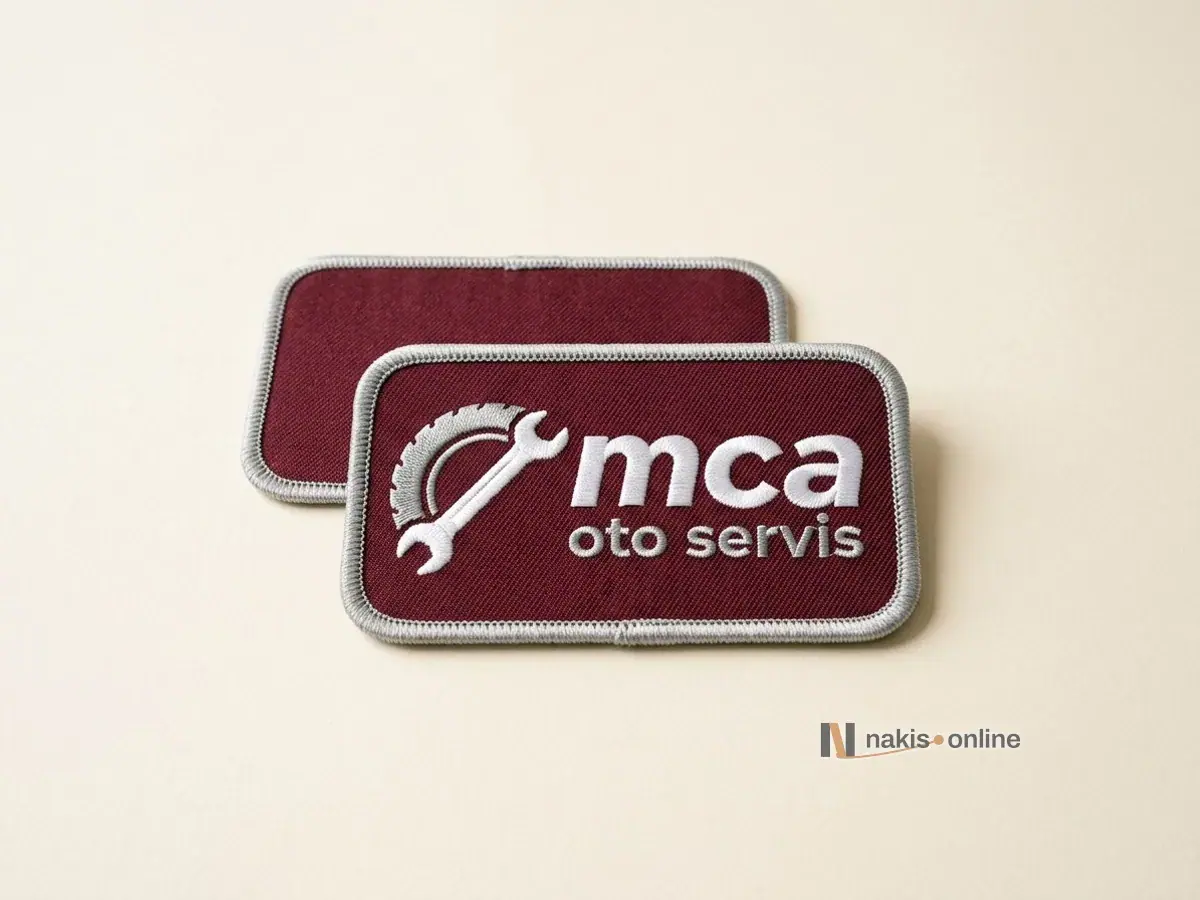
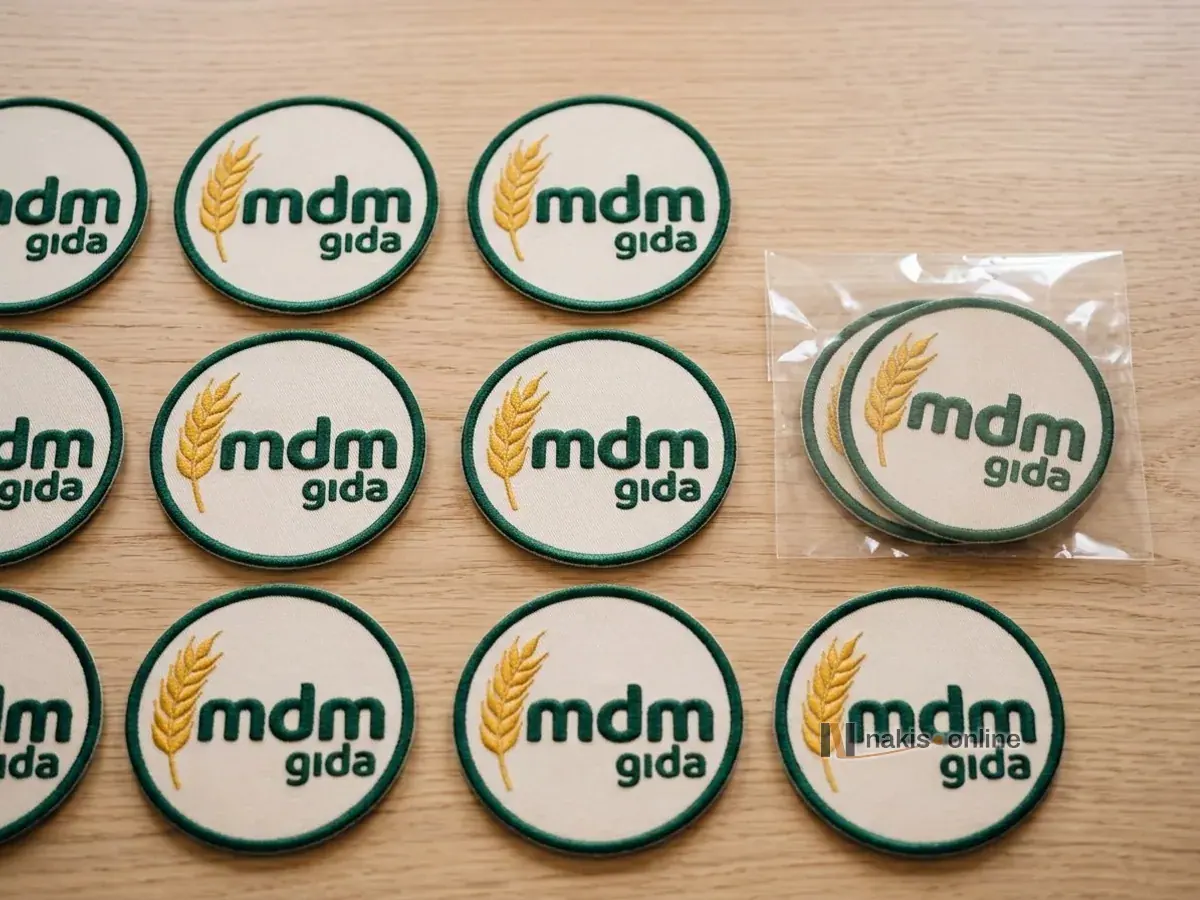
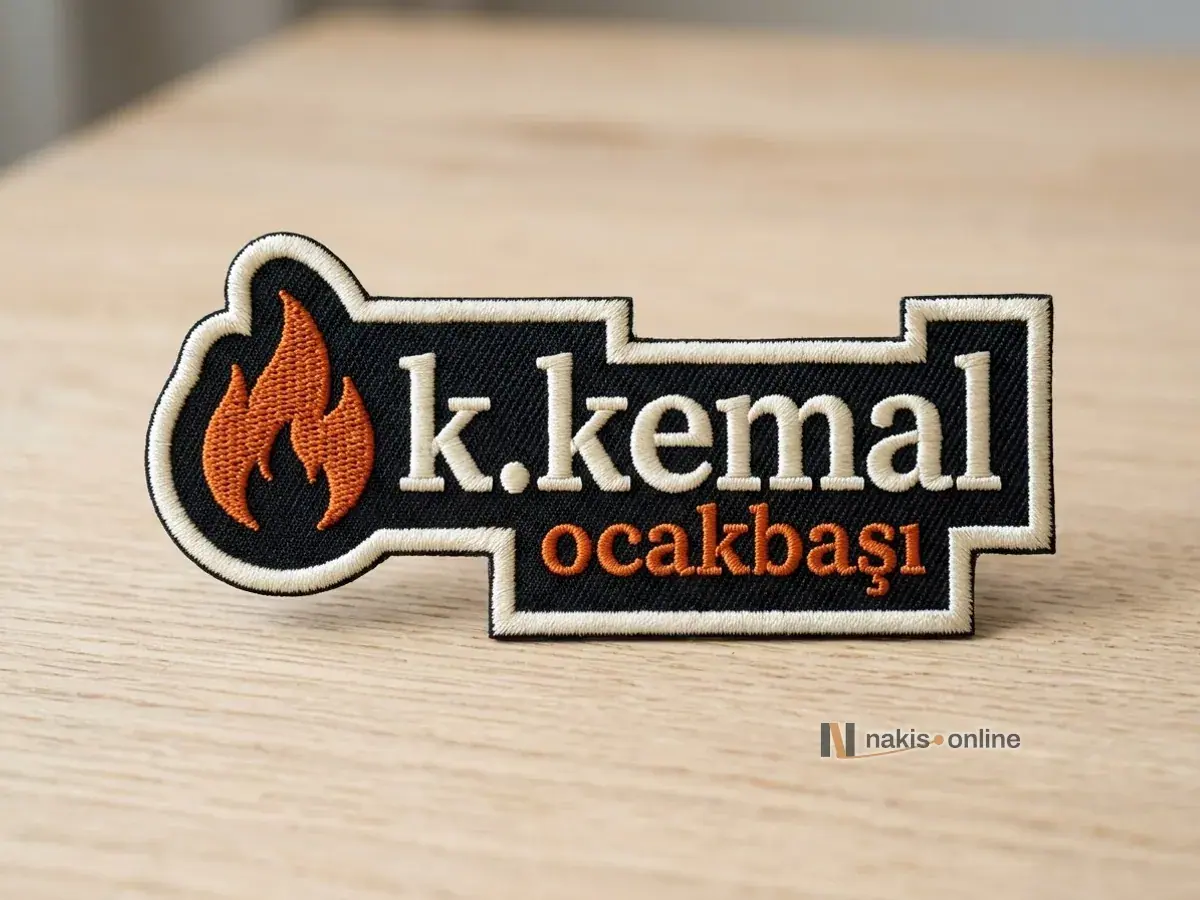
Four decisions for a custom patch: base, edge, back and size
Base. For workwear worn every day, a densely woven twill base is the most common choice; felt gives a softer, matt surface. A patch with its whole background covered in thread takes many more stitches than one that leaves the base open, which shows in the price.
Edge. Regular shapes such as circles, ovals, shields and rectangles get a merrow overlock wrapped around the edge. A merrow edge cannot turn a sharp inner corner, so shapes with indents get a satin border stitched on the embroidery machine, and the patch is cut just outside that line.
Size. The position on the garment decides the size: chest, sleeve or back. For reference, a left-chest logo is usually 7.5–10 cm wide, a sleeve logo 6–8 cm and a back logo 25–30 cm. When the same logo is made noticeably smaller, the file is re-edited: fine lettering and lines close up on a small patch, so we thicken or simplify them. In embroidery, letters should not be smaller than about 5 mm in height, and a satin column needs a width of at least about 1 mm.
| Decision | Options | When to choose which |
|---|---|---|
| Base | Twill, felt | Twill for everyday workwear; felt for a soft, matt look |
| Edge | Merrow overlock, satin border | Merrow on round, oval, shield and rectangle; satin on indented shapes |
| Back | Sew-on, hook-and-loop; iron-on on request | Sew-on for permanent use; hook-and-loop to swap; iron-on plus stitching on washed garments |
| Size | Chest, sleeve, back | Fine detail is thickened or simplified on small patches |
Sew-on, hook-and-loop or iron-on patches?
A sew-on patch is the most permanent. For patches that need to come off and go back on, the hook side of a hook-and-loop tape (often called Velcro) is sewn to the back of the patch and the soft loop side to the garment. It goes that way round because the soft side on the garment does not catch other fabrics when no patch is attached, and does not wear other clothes in the wash. Many work vests, softshells and field jackets come with ready-made loop panels on the sleeve or chest; then the panel sets the size, so please measure its width and height before ordering.
An iron-on (adhesive) back is assessed on request. It is quick to apply, but on garments washed often and hot it can lift at the edges over time, so on those we recommend stitching around the edge as well. If your garments have no loop panel, the soft tape has to be sewn on; whether the matching tape is added to the order and who sews it on is settled in the quote. The same file makes both a sew-on and a hook-and-loop version, so one order can include both.
Custom name badges and name tapes
A name tape is a fabric strip with a person’s name embroidered on it, usually the first name and surname or a name and a job title, sometimes with a small logo at one end. With a hook-and-loop back, the badge is simply swapped when someone leaves or a garment changes hands, which suits shift work and field teams; a sewn-on name tape looks plainer on a garment that stays with one person. Each badge in a batch can carry a different name, from a list you send. In embroidery, letters should not be smaller than about 5 mm in height, and a satin column needs a width of at least about 1 mm. We plan the height of the tape so the longest name fits on one line, and ask you about names that don’t fit.
Our badges are embroidered fabric only: we don’t make metal or plastic name badges. A fabric badge leaves no pin holes, does not break when dropped, and a sewn-on one goes through the wash with the garment.
Appliqué: a large logo without a heavy patch
Appliqué and patches are often confused. A patch is a separate piece attached later; appliqué is stitched directly onto the garment and becomes part of it. In appliqué, the large single-colour areas of a logo are filled with a piece of fabric instead of stitches: the machine first stitches the placement line, the fabric is laid on it and tacked down, the excess is trimmed and the edge is closed with a satin stitch.
It makes sense for big back logos, college-style lettering and bold emblems on sweatshirts, jackets and fleece, where full-fill embroidery would make the garment stiff and heavy. On a small chest logo there is no room to cut and place fabric, and full embroidery gives a cleaner result. Twill, felt and other fabrics give the same logo a different character; the exact colour match depends on the fabric available and is settled in the quote.
From your logo to a batch of patches
Send your logo as a vector file (AI, EPS, PDF, SVG) or the clearest image you have. We digitize it to the patch size in the workshop; we prepare the embroidery file in DST format as standard, and in PES if you ask for it. A sample is stitched on the base, its edge closed, and sent for your approval. After approval, the batch is stitched, cut, edged and backed; for orders of 10–500 pieces, the typical time after sample approval is 3–5 working days. If one order needs patches in different sizes or with different backs, say so: each is seen on the sample.
We deliver patches as separate pieces; whether we also sew them onto garments is settled in the quote, and if you haven’t bought the garments yet, we can source them. If several designs are ordered together, each is digitized and approved separately; whether the minimum of 10 pieces applies per design or to the whole batch is settled in the quote. We apply registered trademarks, club logos and official insignia only on the written order of the rights holder or of an organisation it has authorised.
The price follows from the patch itself: the stitch count (its size and how much of it is filled), the number of colours, the base, the edge type, the back and the quantity. Logo digitizing is listed separately in the quote. For a quote, please send the logo, the size and shape, the base and edge you prefer, the back, the quantity per design and the delivery country.
Questions about custom patches
Can one logo be made as patches in different sizes?
Yes. Chest, sleeve and back patches come from the same logo. When the size changes noticeably, the file is re-edited, because fine lines and lettering close up on a smaller patch. You approve the sizes side by side on the sample.
Which side of the hook-and-loop goes on the patch?
The stiff hook side goes on the patch, the soft loop side on the garment. Set up the other way round, the hooks on the garment would catch other fabrics and wear other clothes in the wash.
Can hook-and-loop patches go through the wash?
Yes; polyester embroidery thread stands up to frequent washing. To keep the hook-and-loop gripping, it is still better to take the patch off, wash it separately and cover the soft side on the garment. In the field, the grip usually fades because the hooks fill with dust and lint, so clean them now and then.
Can patches go on flame-retardant clothing?
Not with standard materials: ordinary polyester thread and nylon hook-and-loop melt in heat. A patch for flame-retardant clothing needs flame-retardant thread, backing and tape, and its use depends on the approval of the garment’s maker. If you have such a job, we discuss it separately at the quote stage.
Quote
Get a quote for your logo patches
Send the logo, the size and shape, the back you need, the quantity per design and the delivery country. We reply in writing with the price, the timing and the shipping cost.
Working hours: Monday–Saturday 08:30–19:00 · Istanbul time (UTC+3)