
Embroidered polo shirts for business
Custom polo shirts with your logo, embroidered in Istanbul from 10 pieces
Custom polo shirts with your company logo: nakis.online embroiders logos on piqué polo shirts in its Istanbul workshop, usually on the left chest at 7.5–10 cm wide, from 10 pieces. Send your own polo shirts or let us source short- or long-sleeve, men’s or women’s fit. Each shirt can carry a different name; the run starts after sample approval.
Last updated:
Key facts
- Minimum order
- 10 pieces
- Polo shirts
- Bring your own, or we source them
- Models we source
- Short or long sleeve; men’s or women’s fit
- Left-chest logo
- Usually 7.5–10 cm wide
- Lead time (embroidery)
- 3–5 working days after sample approval (10–500 pieces); sourcing adds time
- Printed polo shirts
- DTF in our own workshop; on average 3–5 days after order approval
- Embroidery file
- DST as standard; PES on request
- Languages
- Turkish, English, German, Arabic, Russian
Where does the logo go on a polo shirt?
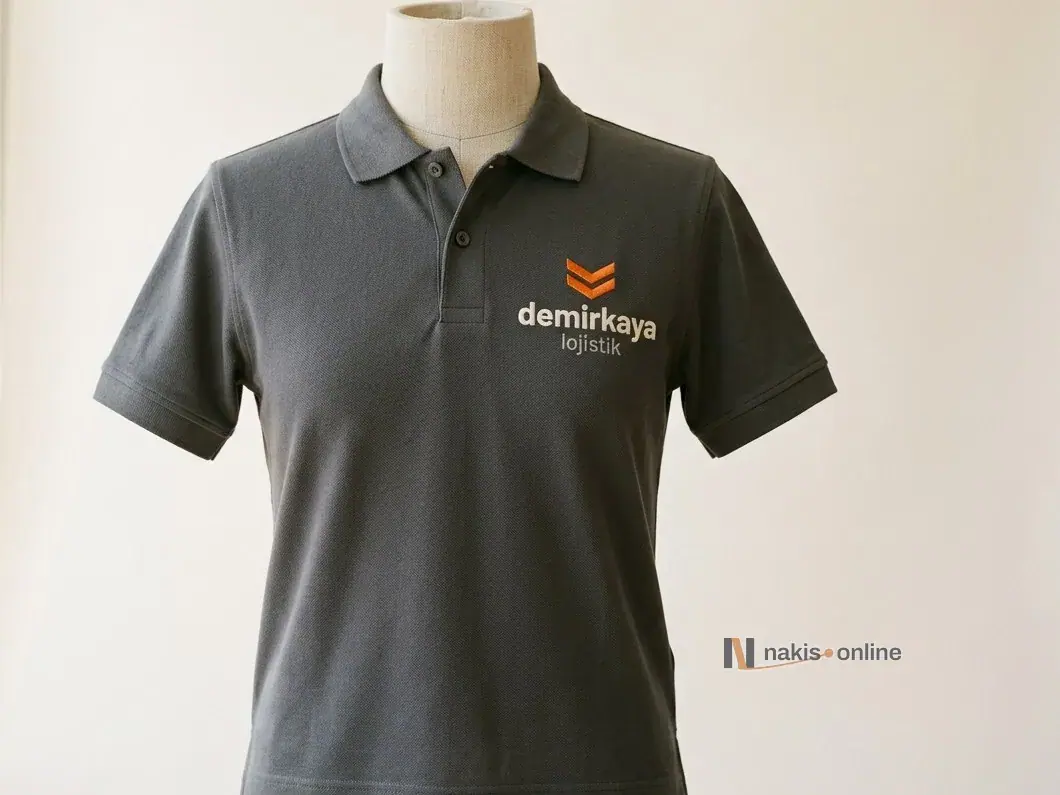
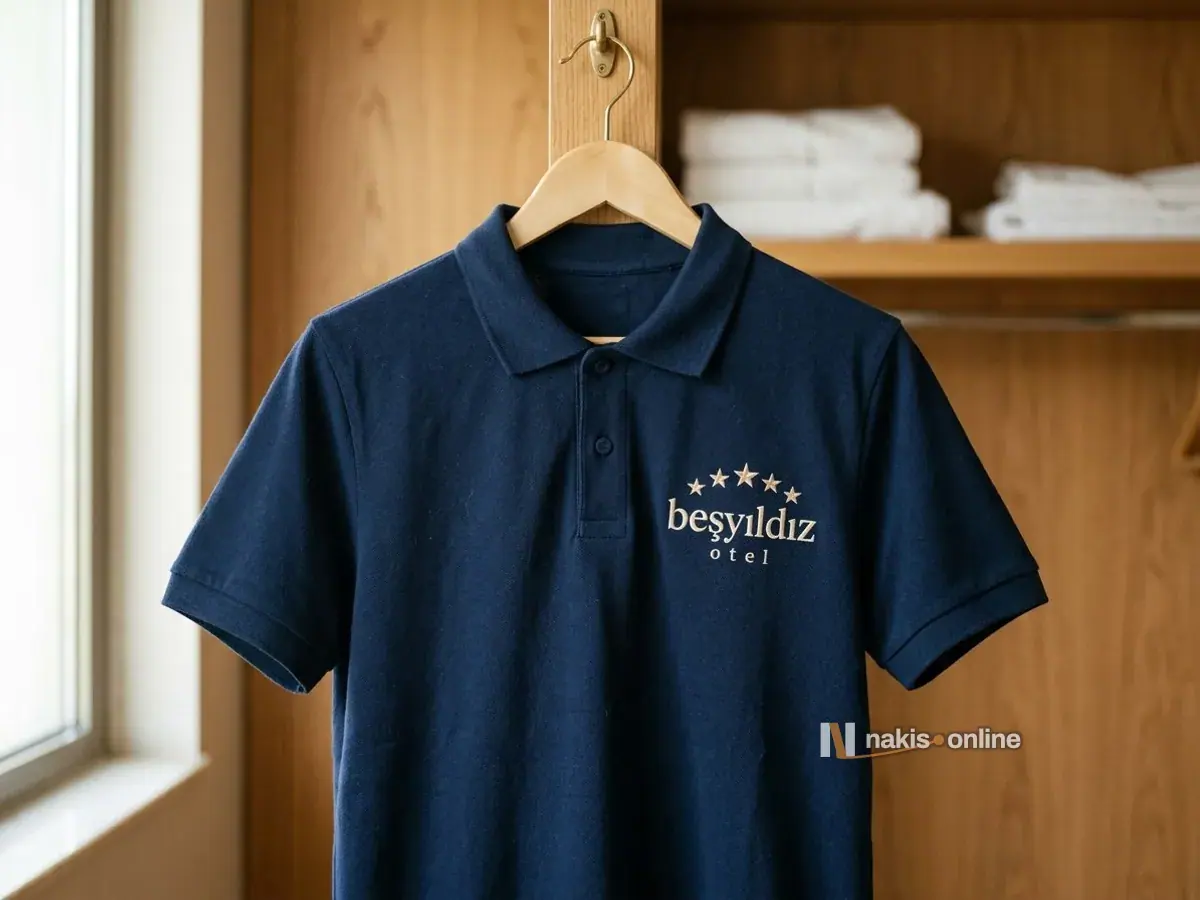
A left-chest logo is usually 7.5–10 cm wide; on a T-shirt or polo shirt it sits about 18–23 cm below the shoulder seam, with its centre about 7.5–12.5 cm to the side of the centre front. Keep at least a finger’s width between the inner edge of the logo and the button placket: if the hoop catches the placket, the fabric does not stretch evenly and the logo sits crooked.
The right chest is the usual place for a name, a job title or a department, at the same height as the logo. A back logo, usually 25–30 cm wide, suits a company name or a lettering-led logo better than a large filled emblem, which feels heavy on piqué. A sleeve logo goes on the upper sleeve, usually 6–8 cm wide. A small logo at the back of the neck is possible too; since its reverse side touches the neck all day, we keep it small and light. These are common ranges in the trade; the exact size is fixed on the sample.
| Position | Usual width | What to watch on a polo |
|---|---|---|
| Left chest | 7.5–10 cm | Centre about 7.5–12.5 cm from the centre front, clear of the placket |
| Right chest | Set on the sample | A name or department, level with the logo |
| Back | 25–30 cm | Company names and lettering carry better than large fills |
| Sleeve | 6–8 cm | Upper sleeve, away from the sleeve hem |
| Back of the neck | Set on the sample | Small and light, as it touches the skin |
Embroidered polo shirts for business: which team wears what?
The same logo is placed differently depending on the job the polo shirt does. Shop and sales teams often carry the logo on the left chest and the employee’s name on the right; reception and hotel staff tend to wear a small, quiet logo; service, technical and delivery teams add the company name across the back, so customers recognise them from behind.
Custom polo shirts with a logo and a name are ordinary batch work: each shirt can carry a different name from your list, while the logo stays the same. Send the names as a spreadsheet or a list with the spelling checked, and mark which name goes on which size. How a named batch counts towards the minimum of 10 pieces is settled in the quote.
| Team | Suggested layout | Why |
|---|---|---|
| Shop and sales | Logo left chest, name right chest | Customers can address staff by name |
| Reception and hotel | Small logo left chest | Smart and understated next to a uniform |
| Service, technical and delivery | Logo left chest, company name on the back | Recognised from behind at a customer’s site |
| Events and trade fairs | Logo left chest, event name on the sleeve | One shirt carries both brand and occasion |
Why does piqué need its own embroidery file?
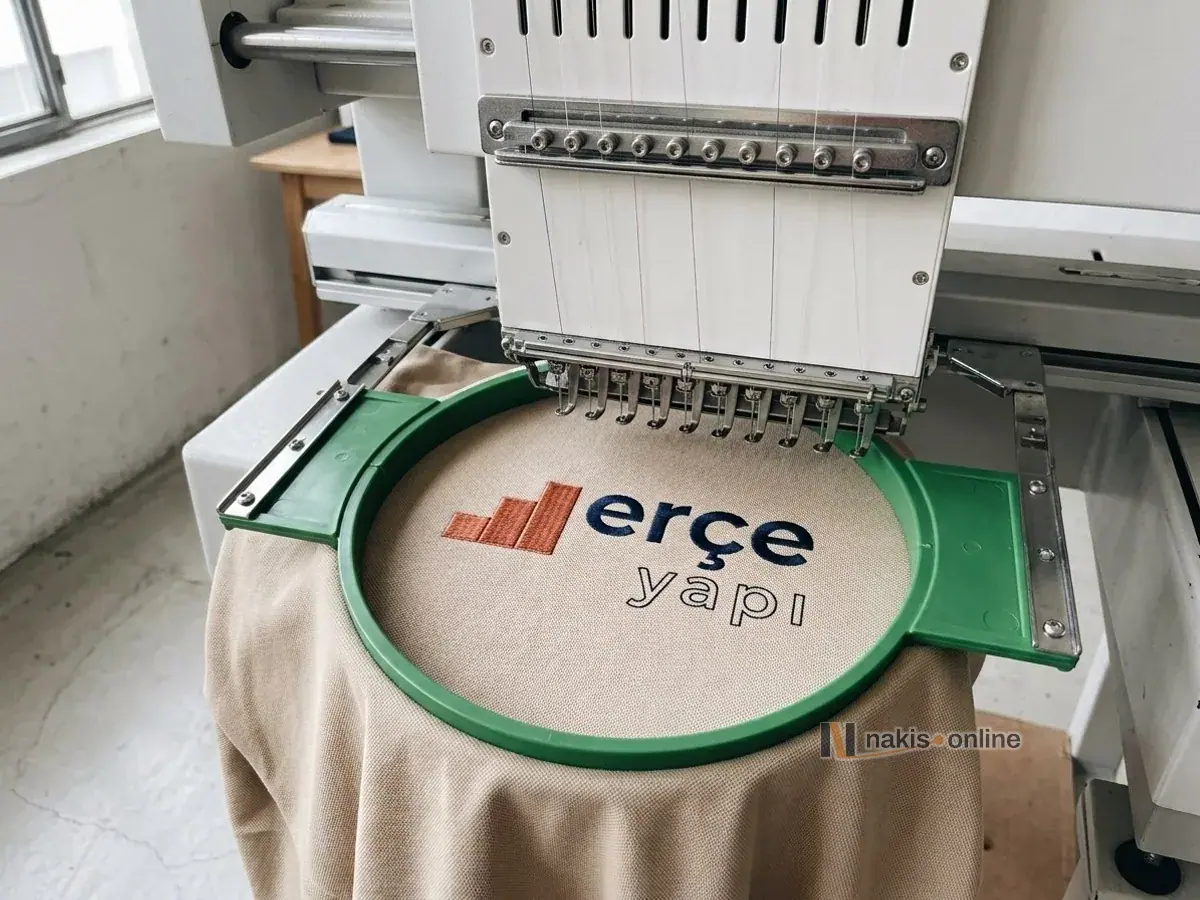
Most polo shirts are made of piqué, a knitted fabric with a small honeycomb texture. Being knitted, it stretches, so a cut-away backing stays behind the logo after stitching and carries that stretch; a tear-away backing is not enough here, and the edges of the logo start to wave after the first washes.
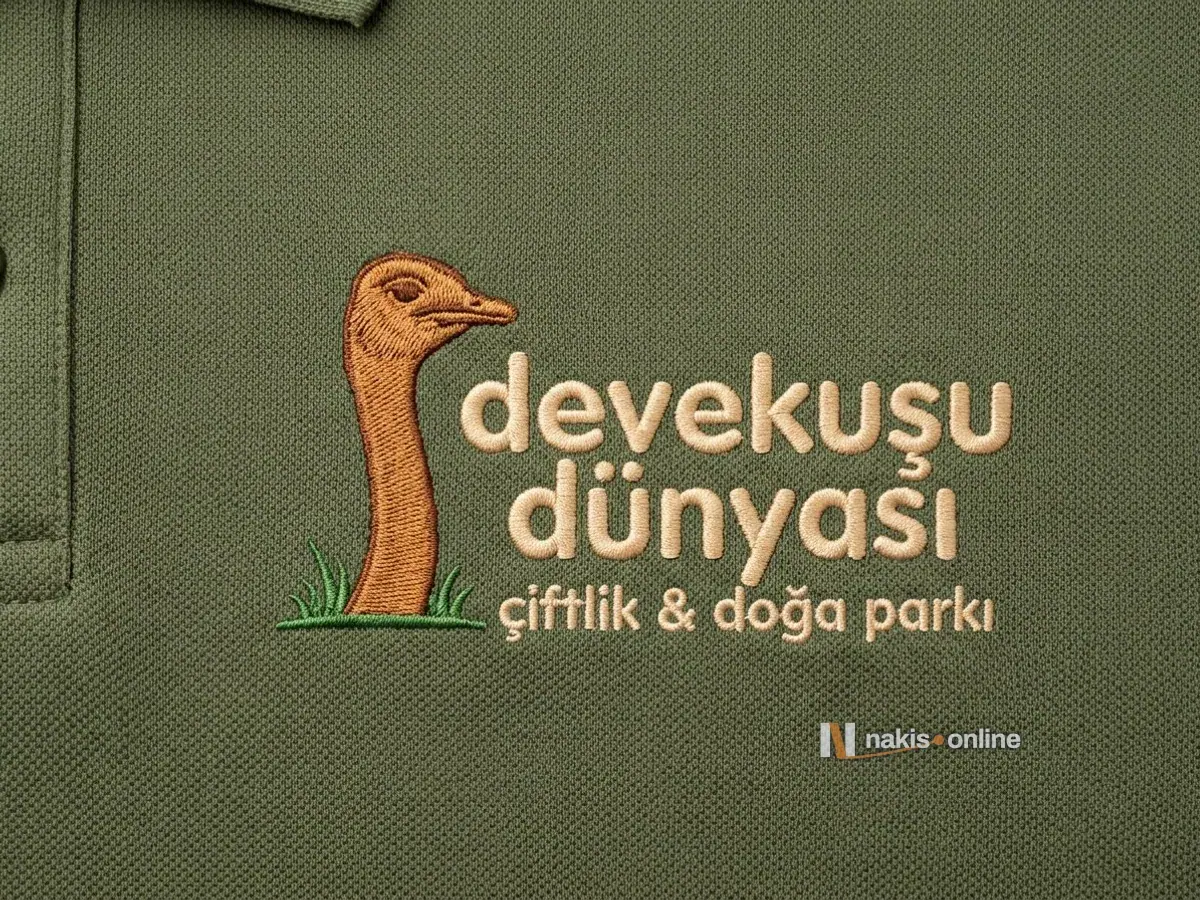
The honeycomb surface can swallow fine lines. During digitizing, we lay underlay stitches that press the surface flat first, and the top stitches sit on them. In embroidery, letters should not be smaller than about 5 mm in height, and a satin column needs a width of at least about 1 mm. If the logo has to be small, we discuss simplifying the lettering before the sample rather than after it.
We stitch on Tajima and Barudan multi-head machines with Madeira polyester thread. On textiles that are washed often and hot, or treated with bleach, the durability comes from the polyester fibre, and for that kind of work we use polyester thread. In practice, the polo shirt itself usually fades before the logo does. Turning it inside out for washing and never ironing directly over the embroidery is enough to keep the logo looking new.
Embroidered or printed polo shirts?
On piqué, embroidery is the natural choice: the logo sits firm and textured on the honeycomb surface and stands up to frequent washing. If your logo is a gradient or a photographic image, or the team’s T-shirts are printed and the polo shirts should match, printing is an option too: next to embroidery, we print polo shirts and T-shirts with DTF in our own workshop. Which one suits your logo is decided with you, based on the design, the fabric and the quantity.
How DTF compares with screen printing, transfer and sublimation is explained on our page about T-shirt printing in Istanbul. A printed order is ready on average 3–5 days after you approve it, plus the sourcing time if we supply the shirts; an embroidered run starts once the sample is approved.
Your own polo shirts, or shall we source them?
If you already have the polo shirts, send them with the quantity per size and colour, and a photo of the care label: cotton, polyester and blended piqué stretch and shrink differently, and the backing, the underlay and the stitch density are chosen to match.
If you would rather we source them, if we source the polo shirts, you can choose short or long sleeves and a men’s or women’s fit. Fabric weight, fibre content, shade and size range are agreed with you in the quote, and the time needed to obtain the polo shirts is added to the lead time. The sample is embroidered on the polo shirt chosen for the run, so you approve the logo on the real garment.
Which polo colours, and which thread on each?
When we source the polo shirts, the colours ordered most often are black, grey, navy, red, green, white, burgundy, khaki and royal blue; whether another shade is available is settled at the quote stage. On a white polo, dark and saturated corporate colours work as they are, while pale yellow and pastels disappear. Grey and khaki are mid-tones: unless the thread is clearly lighter or darker, the logo fades from a few steps away.
If one batch mixes polo colours, the embroidery file stays the same, because a DST file carries the stitches, not the thread colours; for each polo colour, the threads on the machine’s needles are chosen separately. We agree which thread goes on which colour in a short list before the sample. A tone-on-tone logo can be lifted from the matt piqué by the sheen of viscose thread.
What decides the price of embroidered polo shirts?
We don’t publish prices; the quote is written for your logo. The price depends on the stitch count, the number of colours, the number of logo positions, the quantity and the product; we give you the quote in writing. Logo digitizing is listed separately in the quote. The examples below show which line of the quote each decision moves.
| Example order | Main factor | What changes in the quote |
|---|---|---|
| Your polo shirts · 10 pieces · two-colour logo on the left chest | Stitch count, colours and quantity | No garment line; embroidery, plus logo digitizing listed separately |
| Polo shirts sourced by us · short sleeve, navy and white | Product | The polo shirts are added as their own line; the model chosen sets it |
| The same order · company name on the back as well | Number of positions | The back is hooped separately; lettering 25–30 cm wide takes fewer stitches than a filled emblem of the same width |
From sample to delivery: what to send for a quote
We prepare the DST embroidery file from your logo and embroider a sample on one of the polo shirts. Once you approve it, the run is stitched to the same settings; for orders of 10–500 pieces, the typical time after approval is 3–5 working days. Keep one approved shirt: it makes a later reorder easy to match. For a quote in one round, please send:
- your logo file, vector if you have it, and the positions: left chest, right chest, back, sleeve or neck
- your own polo shirts, or the sleeve length, fit and colour if we source them
- the quantity per colour, fit and size
- a photo of the care label, if you send your own polo shirts
- the list of names, if the right chest carries one
- the delivery city and country, and the date you need them by
Questions about embroidered polo shirts
Does a chest logo make a polo shirt itchy?
Not when it is prepared properly. The cut-away backing behind a left-chest logo lies flat on the inside of the piqué. The place that needs care is the back of the neck, where the reverse of a logo rubs the skin all day; we keep a neck logo small and light, and for sensitive wearers suggest the sleeve instead. Wearing the sample through a working shift is the surest test.
Can long-sleeve polo shirts be embroidered too?
Yes. The left-chest logo goes in the same place and at the same size as on a short-sleeve polo. A sleeve logo sits on the wide upper part of the sleeve, close to the shoulder seam, usually 6–8 cm wide. We can source long-sleeve polo shirts as well; colours and sizes are agreed in the quote.
Why do you ask for the fabric content of the polo shirts we send?
Because the backing, the underlay and the stitch density are chosen for the fabric. Cotton, polyester and blended piqué stretch differently and shrink differently in the wash; the same logo can lie flat on one and wave on another. A photo of the care label is enough, and if the content is unknown, the sample answers the question, since it is stitched on one of your own shirts.
Polo shirt or T-shirt for our staff?
A polo shirt looks more formal and suits teams who meet customers face to face; a T-shirt suits warehouse and event teams. For embroidery the difference is the fabric: piqué’s honeycomb challenges fine lines, while jersey stretches more. The same logo works on both, with the file adjusted to each fabric; printed T-shirts are covered on our T-shirt printing page.
Quote
Get a quote for your logo polo shirts
Send the logo, the positions, the colours, the quantity per size and the delivery country. We reply in writing with the price, the timing and the shipping cost.
Working hours: Monday–Saturday 08:30–19:00 · Istanbul time (UTC+3)