
In-house DTF printing for T-shirts and hoodies
T-shirt printing in Istanbul: your logo on T-shirts and hoodies, from 10 pieces
T-shirt printing in Istanbul for companies, teams and events: nakis.online prints custom T-shirts and hoodies with your logo in-house, by DTF or embroidery, from 10 pieces. Send your own shirts or let us source them. Printed orders are ready on average 3–5 days after you approve the order; sourcing the shirts adds time.
Last updated:
Key facts
- Minimum order
- 10 pieces
- Printing method
- DTF (direct-to-film), in our own workshop
- Lead time (print)
- On average 3–5 days after order approval; sourcing adds time
- Lead time (embroidery)
- 3–5 working days after sample approval (10–500 pieces)
- Languages
- Turkish, English, German, Arabic, Russian
DTF, screen printing, transfer or sublimation: what is the difference?
Four printing methods cover most logo T-shirts, and we print with one of them: DTF, in our own workshop. Screen printing, transfer and sublimation are described below as general information, so you can compare them and see where each one is strong and where it reaches its limits.
DTF (direct-to-film): the method we use
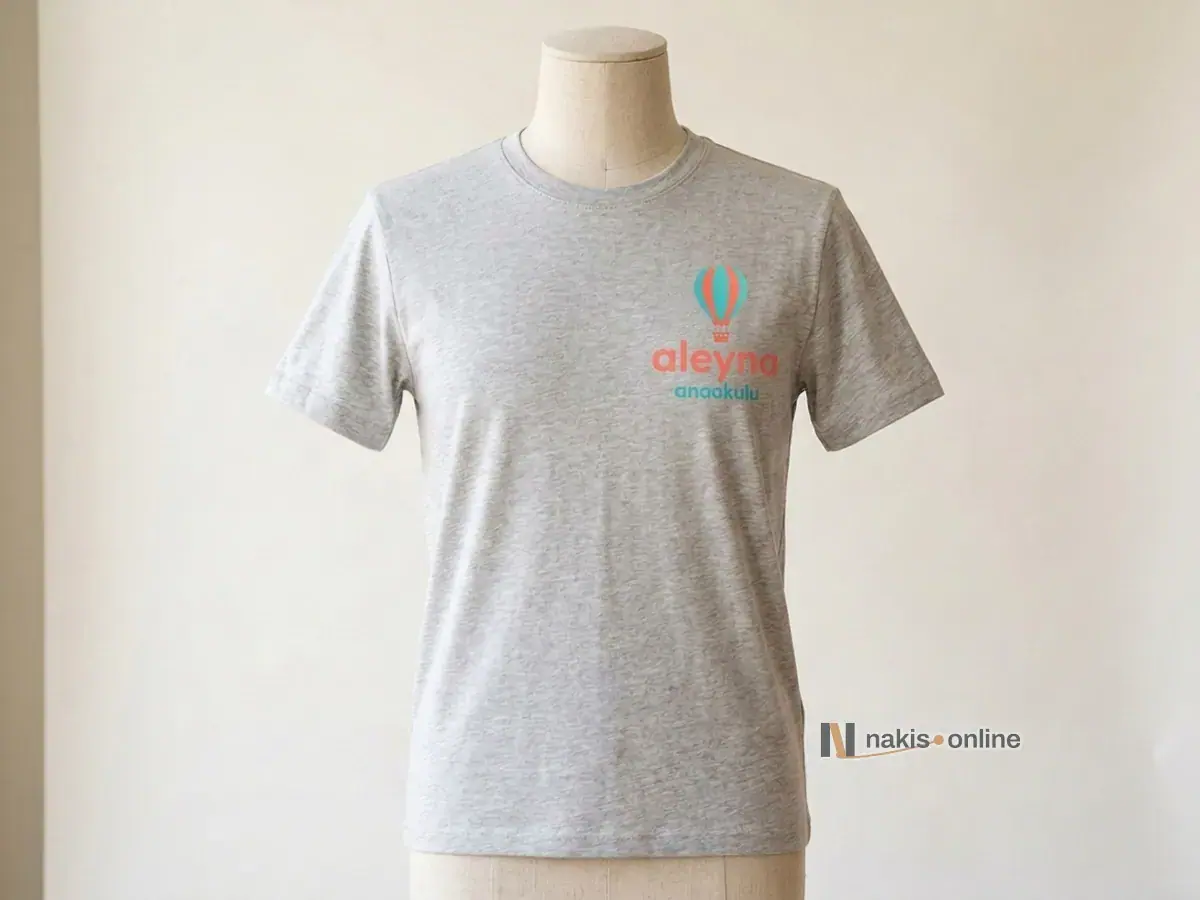
The design is printed onto a film with a white base layer, coated with adhesive powder and heat-pressed onto the shirt. DTF works on cotton, polyester and blends, light or dark, and handles multicolour logos, gradients and fine detail without a separate set-up for each colour, which suits small batches. The print is a thin, flexible layer you can feel; over a very large solid area, it makes the fabric noticeably stiffer.
Screen printing
Ink is pushed through a fine mesh screen, one screen per colour. The colours are strong and opaque, and a well-cured print lasts a long time. Since each colour needs its own screen and set-up, the method suits designs with a few flat colours, and the set-up weighs less the longer the run.
Transfer (cut vinyl, also called flex)
Strictly speaking, DTF is a transfer too: any method that prepares the design on a carrier sheet and applies it with heat belongs to the family. When printers say “transfer”, though, they usually mean cut vinyl: the design is cut from coloured vinyl, the excess is weeded out and the rest is heat-pressed onto the shirt. Vinyl gives clean, solid shapes such as names, numbers and simple logos, but fine detail is hard to cut, each colour is cut and pressed separately, and large areas feel stiff.
Sublimation
Heat turns special inks into a gas that bonds with polyester fibres, so the print becomes part of the fabric and cannot be felt. It only works on white or light-coloured polyester: on cotton, or on a black shirt, it is not an option.
Printed or embroidered: which is better for company and team T-shirts?
On a T-shirt, the fabric often decides. Most T-shirts are single jersey, a thin, stretchy knit: a DTF print adds little weight to it, so back designs, photos and small text work well. Embroidery on jersey needs a cut-away backing and a lighter density; a left-chest logo or a name then looks crisp and lasts, while a large, dense back logo pulls the fabric.
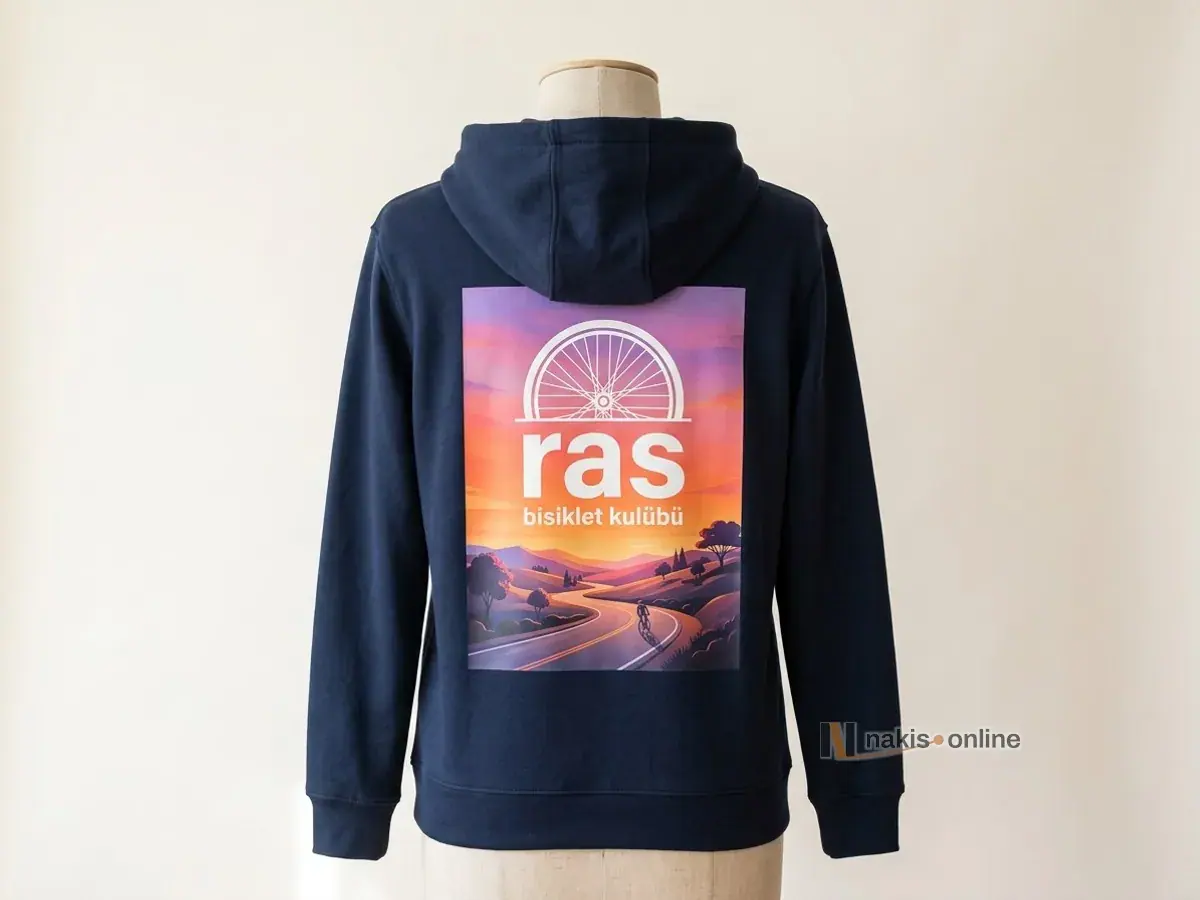
On heavier garments washed hot and often, such as polo shirts, hoodies and work jackets, embroidery comes into its own: the polyester thread we use keeps its colour through hot washing and bleach, while a print lasts longest with moderate washing and gentle drying. The two can also be combined, for example an embroidered chest logo and a printed back on the same hoodie; the timing of a combined order is set in the quote.
| Aspect | DTF print | Embroidery |
|---|---|---|
| Works best for | Photos, gradients, fine text, many colours | Solid-colour logos, names, small emblems |
| On a thin T-shirt | Thin layer; a very large solid area feels stiffer | Cut-away backing and moderate fills |
| On hoodies and sweatshirts | Front and back designs | Chest, name or sleeve; dense fills are fine |
| Lead time | On average 3–5 days after order approval | Typically 3–5 working days after sample approval (10–500 pieces) |
Bring your own T-shirts or let us source them?
Either way works. If you send your own shirts, tell us the fabric (cotton, polyester or a blend), the colours and the quantity per size: for DTF printing, the fabric decides the pressing temperature and time, and for embroidery it sets the backing and the density.
If you would rather we source them, tell us crew or V-neck, the colour, the size split and whether you want a lighter or a heavier shirt. We obtain the shirts, add your logo and deliver them; model, colour and sizes are agreed in the quote, and the time needed to obtain the shirts is added to the lead time. Hoodies and polo shirts for the same team can be sourced in the same order.
What artwork should you send, and where can the logo go?
For print, vector artwork (AI, EPS, PDF or SVG) is preferred because it scales without losing sharpness. If you only have a PNG or JPG, send it anyway; whether it can be printed as it is or needs redrawing is confirmed in the quote. A logo on a transparent background is the easiest to work with; if yours sits on a white box, say whether the white belongs to the design. Mention the shirt colour too, since a design made for white shirts often needs different colours on black.
A left-chest logo is usually 7.5–10 cm wide; on a T-shirt or polo shirt it sits about 18–23 cm below the shoulder seam, with its centre about 7.5–12.5 cm to the side of the centre front. A back logo is usually 25–30 cm wide, a sleeve logo usually 6–8 cm. These are common ranges in the trade, not a template. For a printed order, the exact size and position are confirmed in writing before production, and whether you see a printed sample or a digital preview first is settled in the quote.
| Position | Usual width | Where it sits |
|---|---|---|
| Left chest | 7.5–10 cm | About 18–23 cm below the shoulder seam; centre about 7.5–12.5 cm from the centre front |
| Back | 25–30 cm | Centred across the back |
| Sleeve | 6–8 cm | Upper sleeve |
When will a printed order be ready?
Printed work is ready on average 3–5 days after you approve the order; if we source the products, the time needed to obtain them is added. The days count from your approval of the order, not from your first message, so a request that already includes the artwork, the quantity per size and the delivery address gets to approval sooner. The transit time comes on top and depends on the destination country.
Embroidered items follow their own timetable: typically 3–5 working days after sample approval for orders of 10–500 pieces, with digitizing and the sample round before that. Working to a fixed date, such as a trade fair or a launch? Put it in your first message, so the printing and the sourcing can be planned around it.
Custom T-shirts for companies, teams and events: what do we need for a quote?
Staff shirts, team shirts and event shirts for a fair, a run or a launch all start the same way. Your own logo is the normal case; club crests, other brands’ logos and official insignia are not. We apply registered trademarks, club logos and official insignia only on the written order of the rights holder or of an organisation it has authorised.
For printed work, the price depends on the size and position of the print, the quantity and the product; we give you the quote in writing. For a quote in one round, please send:
- your logo file, vector if you have it, with any Pantone references
- the garment, and whether you send it or we source it
- the quantity per size and per colour
- the positions, and roughly how big each logo should be
- a list of names, if each shirt carries a different one
- the delivery city and country, and the date you need the shirts by
Delivery across Türkiye and abroad: what is agreed in the quote?
The finished shirts go out from our Istanbul workshop to addresses across Türkiye and abroad. We don’t tie ourselves to one carrier: the courier and the transit time depend on the destination country, and the shipping cost is set in the quote.
For shipments abroad, customs and taxes are on the table at the quote stage too, and we help you through the process. Import duties and taxes are set by the destination country and depend on the goods; we don’t act as a customs broker, so if you import regularly, your own broker can tell you what applies.
Quotes and order details can be handled in writing in English, as well as in Turkish, German, Arabic or Russian, on WhatsApp or by e-mail.
Questions about printed T-shirts
Can a logo be printed on black or navy T-shirts?
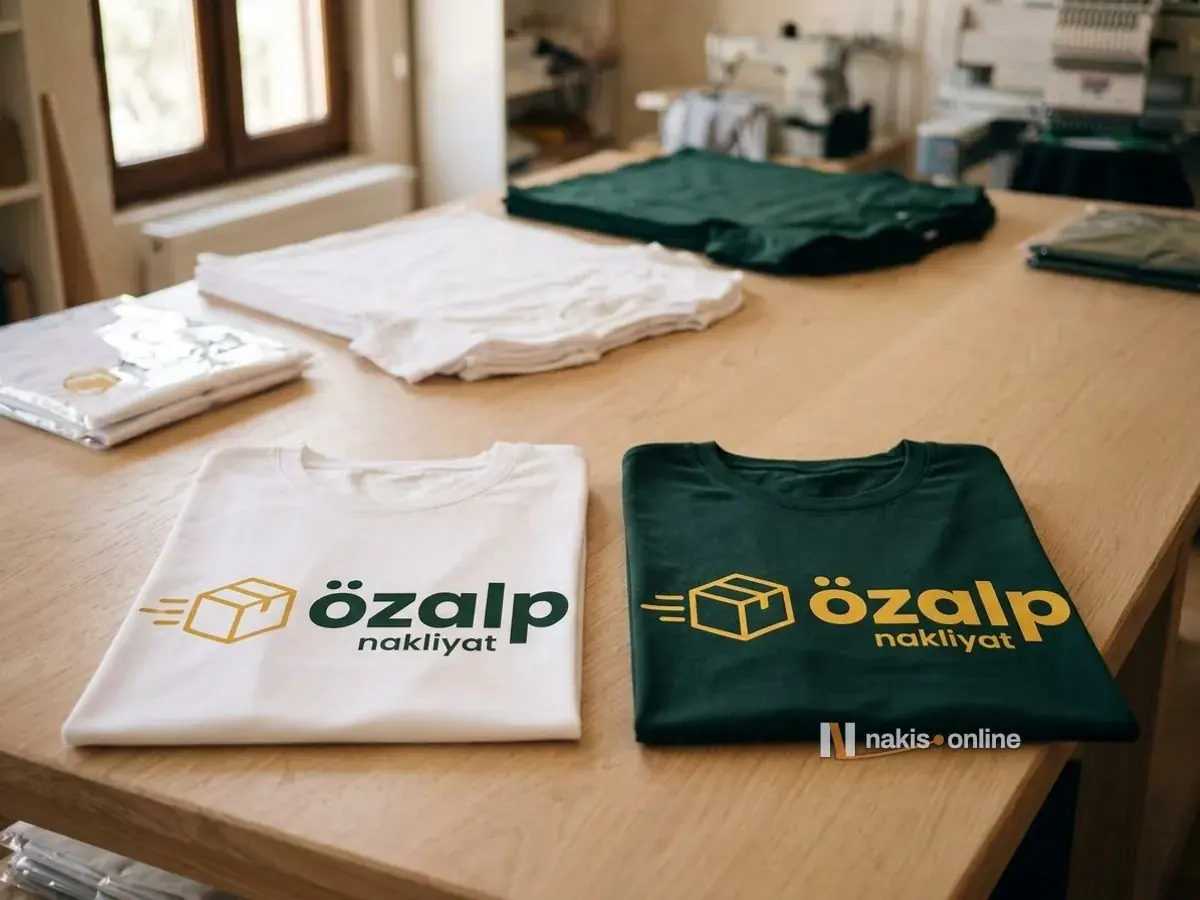
Yes. A DTF print carries its own white base layer under the colours, so light colours stay bright on black or navy instead of sinking into the fabric. Tell us the shirt colour in your request: a design made for white shirts sometimes needs its colours adjusted for dark ones, and whether you see a printed sample or a digital preview first is settled in the quote.
How should printed T-shirts be washed so the logo lasts?
Turn them inside out, wash at a moderate temperature without bleach, use a low dryer setting or none, and never iron directly over the print. These habits protect the thin film layer of a DTF print; for shirts that go through an industrial laundry every week, an embroidered logo may be the better choice.
Can each T-shirt have a different name?
In embroidery, yes: a different name on each shirt is ordinary batch work, as long as the batch has at least 10 pieces. Send the names as a list with the spelling checked. For printed names, whether and how they are done is settled in the quote.
Quote
Get a quote for your logo T-shirts
Send the logo, the quantity per size, the shirt colour and the delivery city or country. We reply in writing with the price, the timing and the shipping cost.
Working hours: Monday–Saturday 08:30–19:00 · Istanbul time (UTC+3)